
For some reason I’ve had respect for water and its storage and usage for as long as I can remember. I noticed old schemes where water was collected into basement tanks for pumping round the house in houses off the beaten track. I wondered at the engineers in the past who built reservoirs and even channels running miles round the contours of our hillsides to move water from one system to another to maintain water pressure. I realised that water often gets re-used as it moves down hill. When we had a drought in Yorkshire in the 1980’s my attention to water became even more focused. The site of streams of water tankers arriving on a hillside to pour water down into a reservoir was something to behold. I started finding containers to store water from roofs wherever possible. In our present garden we have taken that much more seriously.
When I built a large shed in the garden, I channeled the water from both sides of the roof round to a water butt at one side. When it was obvious that the butt was often overflowing, I connected a second to the first and then a third.
I did the same with the roof of a lean-to extension on the house and when both barrels there overflowed I realised I could feed the pond at the bottom of the garden, so ran a hose all the way down along the hedge line.
The biggest, yet still simple, scheme was when we put an overhang along the front of the house, which broke the line of the gutter downpipe. We had the builders just feed the shortened pipe into the new gutter and I piped that along the side of the house and into more barrels. Because they often overflow, I put a drip feed pipe from them back along the side of the house to water a normally arid piece of raised garden there.
In total there are now more than 10 water collection points. We even collect some grey water into a butt that normally gets fed by the roof at the back of the house. That one overflows into the drain.
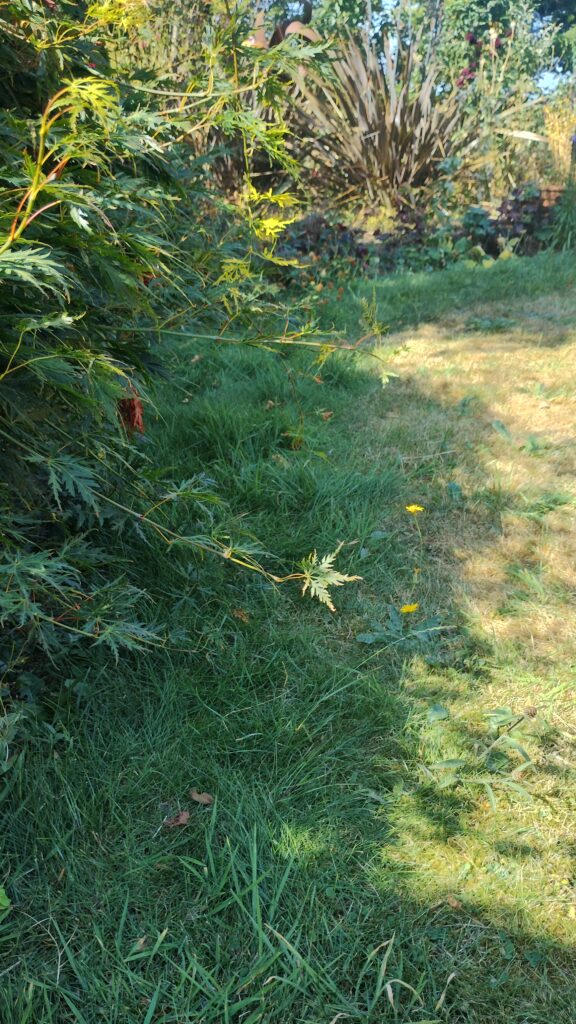
All year round we use less water for our very green and colourful, wildlife friendly garden. That means more water for other people. Collecting the rainfall from every bit of roof means we make the most of what we get. It is worth mentioning that that the design of the garden, with plentiful trees and shrubs giving levels of shade, also reduces water use. The drought conditions picture below shows the greening effect of that shade on a patch of grass. South is left on the picture, so the shade has effect for the main part of the day.
At some point Ruth’s daughter set up home in New Zealand. When we visited we realised that the house collected all the rainwater off the roof into a big tank, to provide the water supply for the house. When I visited the local builders merchant and asked about rain butts, to collect water from a separate lean-to roof for use in the garden, they pointed me at tanks big enough to live in. Even in NZ though, there is still too little attention paid to water. Gardens are set up for having BBQ’s and too little attention is paid to shade. In similar drought conditions, those water tankers are going to individual houses to re-fill tanks.
Back in the UK, for too many years we have just assumed that someone else will provide us with as much water as we want. Builders have been allowed to build without thinking about water seriously either in terms of collection but also run-off. The result is that our ground is increasingly arid while at the same time we have increased flooding. The increasingly arid soil is also part of the problem creating more wildfires.
I used the word respect at the top of this article. I’ll add another – responsibility. There is often not a lot that we can do, as individuals, to change things for the better but we can help by showing respect for our utilities. If you can, set a water butt to collect water to use on your plants. In droughts like the present, I even take the washing up water and throw it over the lawn to help keep it alive.