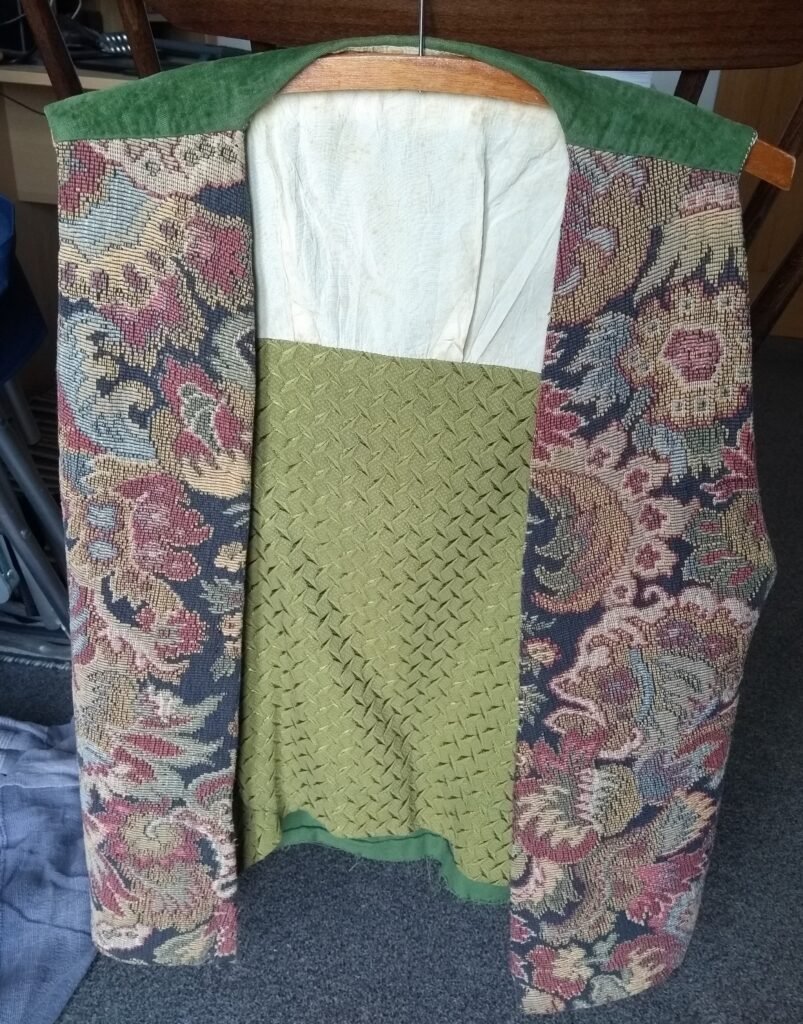
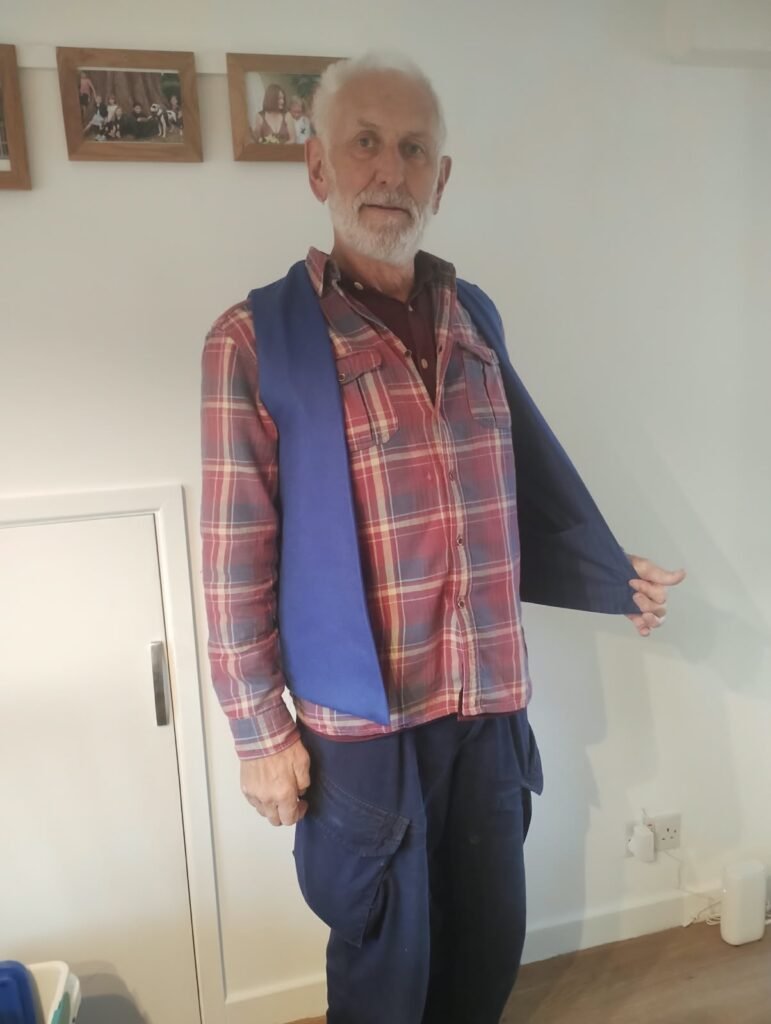
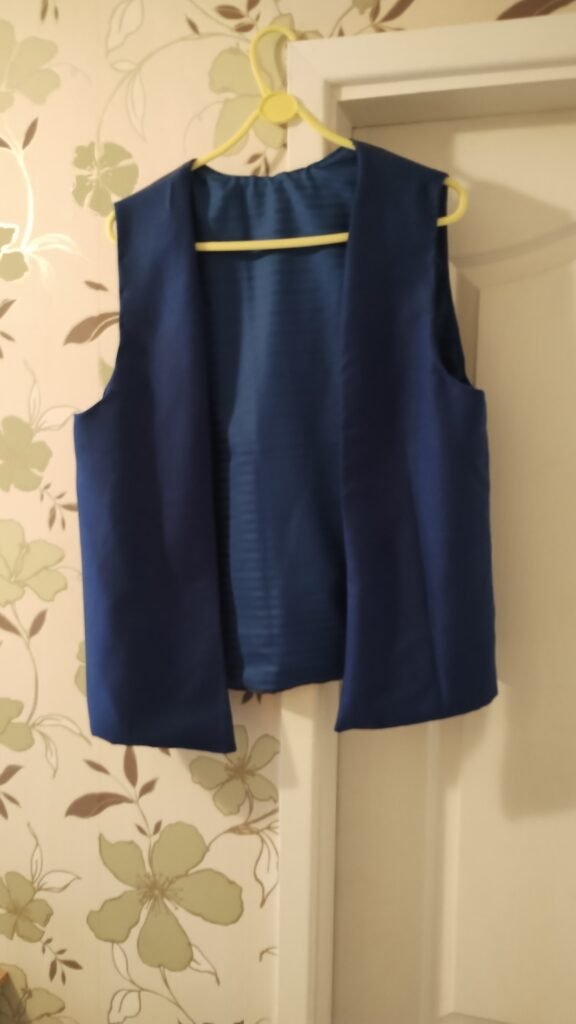
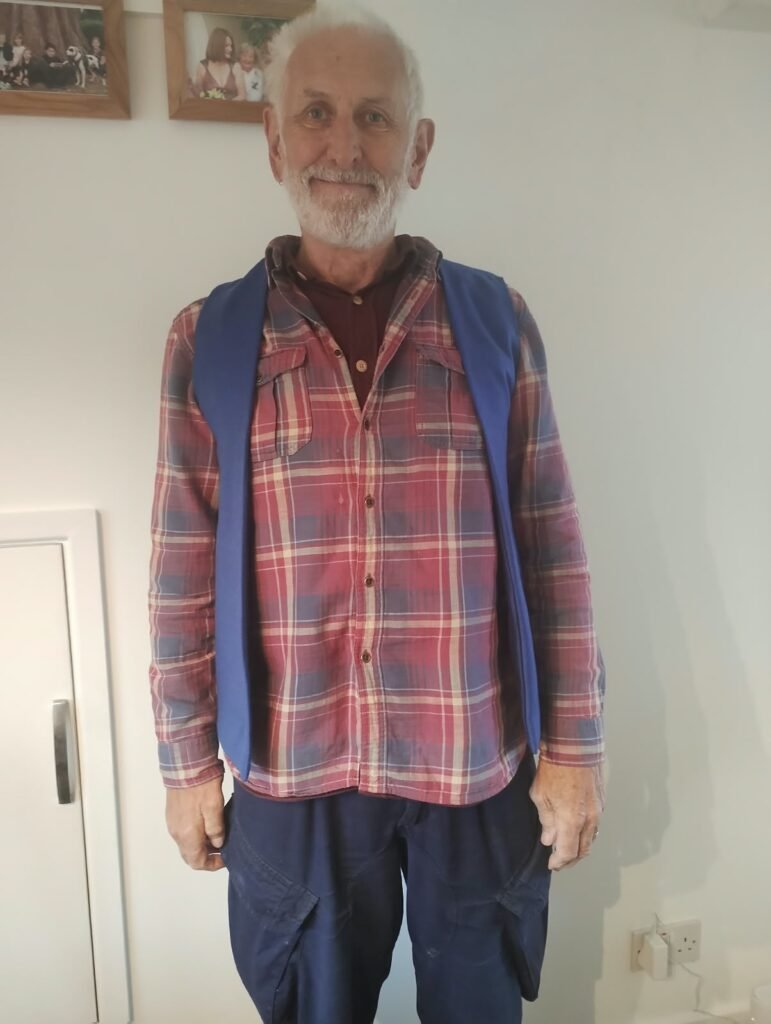
I set myself a summer project when I was at college and, with the help of my mum, made a waistcoat that is still in use today. This year I decided to try it again.
So with the help of Sam Chandler and Julie Fish, I managed another one made out of beautiful materials.
I’ve always been lucky enough to be able to develop skills. Those skills have drawn other people’s attention which is a mood boost but which can also put you under pressure.
I’ve taken the privilege of that attention seriously and watched others to help develop those skills further. I’ve never taken things for granted. I try to push boundaries on my abilities and widen the range of messages I can include in work. I also love to try to pass skills on to others. I learn from that as well. So here are some examples of development that I hope will encourage you to keep going.
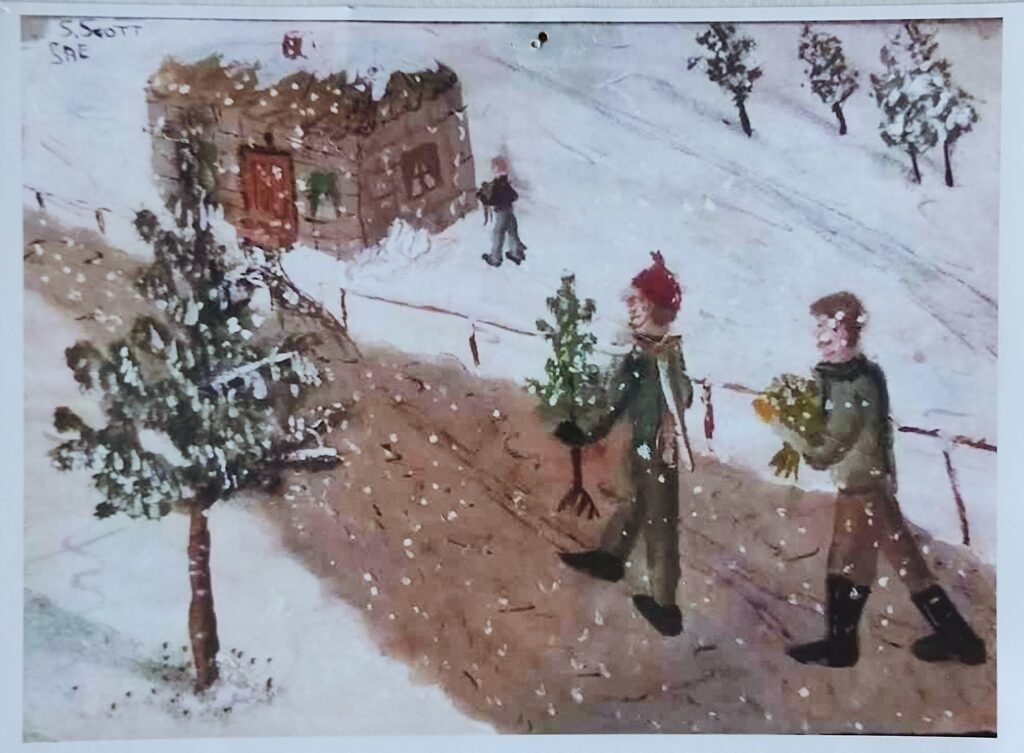
School Christmas Scene
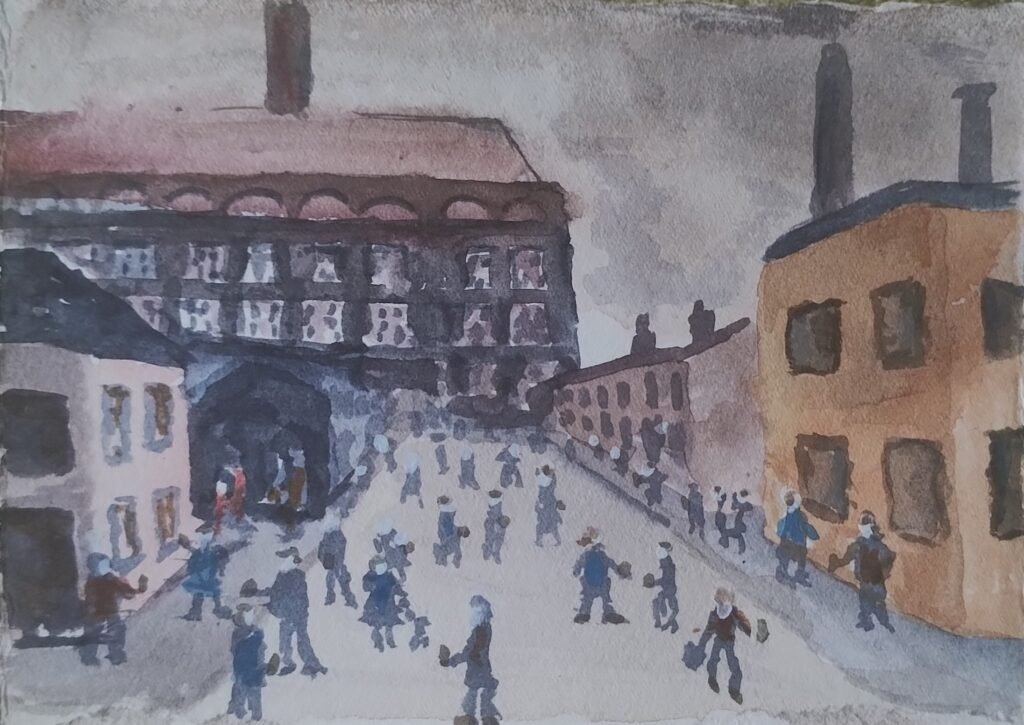
This was done in the mid 1960’s with gouache, which is not the easiest thing to paint with. I was a naive 15 year old with no experience of painting scenes, no real knowledge of art and I made the whole thing up without reference to any other images. Other people had more sophisticated painting and drawing skills than me but it wasn’t a bad painting. Apart from a Gandalf on someone’s window, I rarely painted people again until this next one.
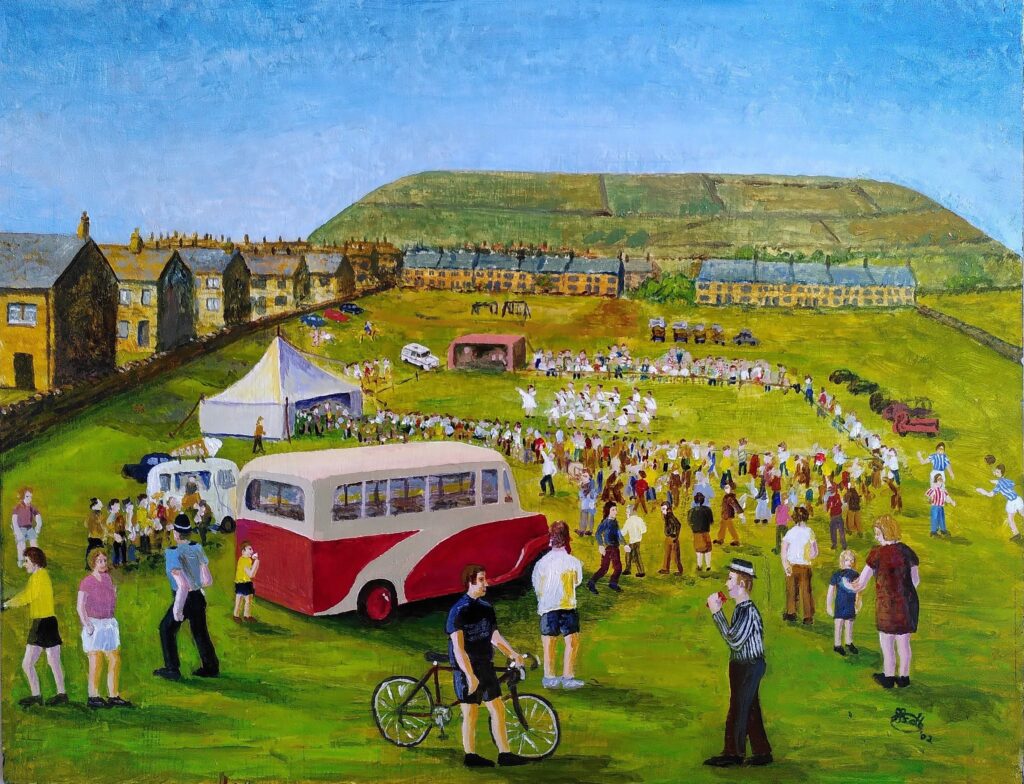
Meltham Carnival re-coloured
This was started in the 20th Century and finished in the 21st. People like it, despite its slight naivety. I knew the place and used some photos to remember things like the bus. The scene arrangement is completely made up as I painted it. Because it is in acrylic I was able to paint over and improve it over time.
Long Company Mumming
This is a real place again and a real event and photos were used as guides. The details of the scene itself and the figure placements are completely imagined. By this time I was starting to be more able to make decisions about tonal and colour balances and levels of detail required. Acrylic paint allowed me to develop the scene steadily, starting from overall colour and light ideas and developing and building up layers, even removing bits that don’t work.
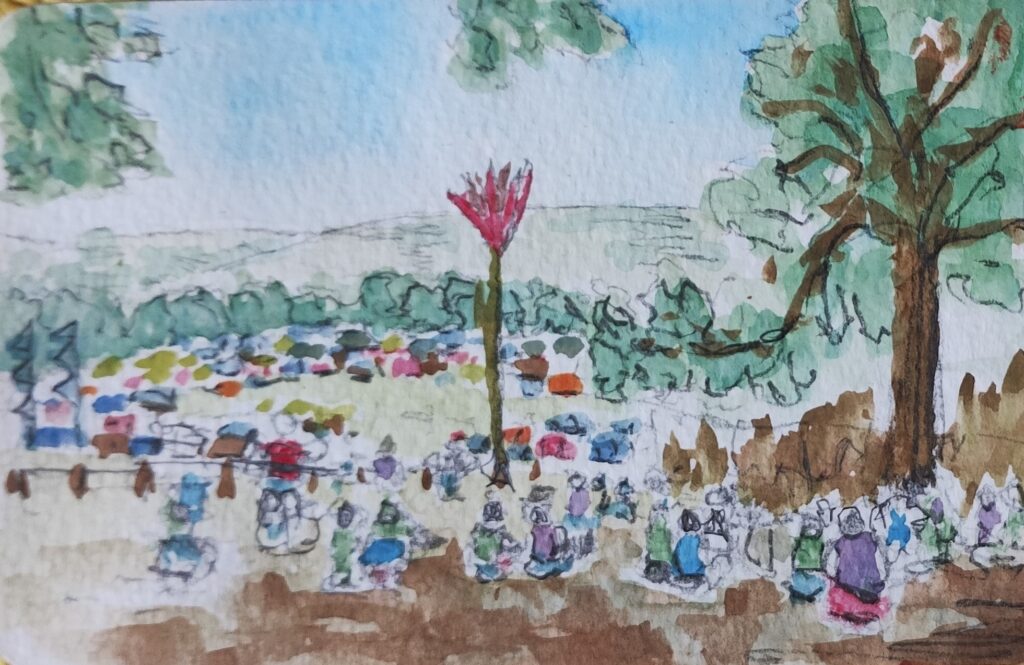
This is just a sketch from a music festival. This one manages to capture a scene without getting too trapped in detail. Watercolour usually forces you to make compromises to capture a rapidly changing scene. Freedom of expression is sometime too easily forgotten. My growing skill with the medium has given me that freedom. By this time the work on the more formal scenes and constant practice on site have given me a more relaxed level of control. Whether you are working from a scene in front of you or one built up from one or more photographs, the aim is to get to a point where you are building a painting rather than copying what is front of you.
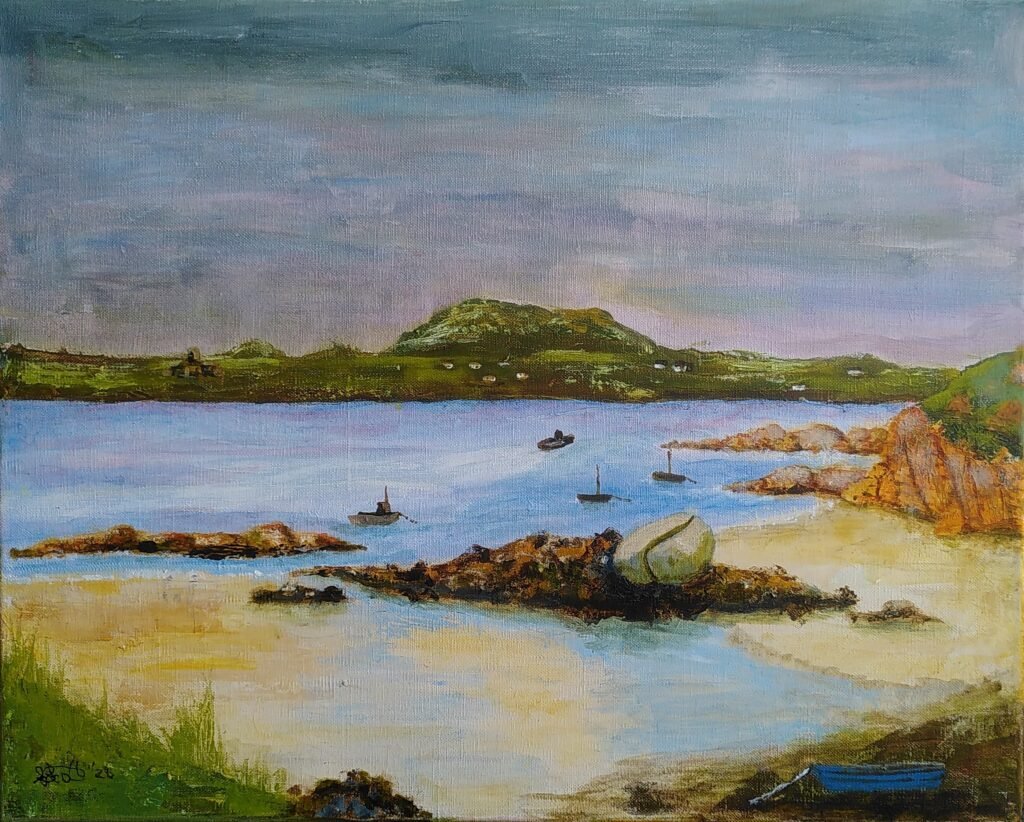
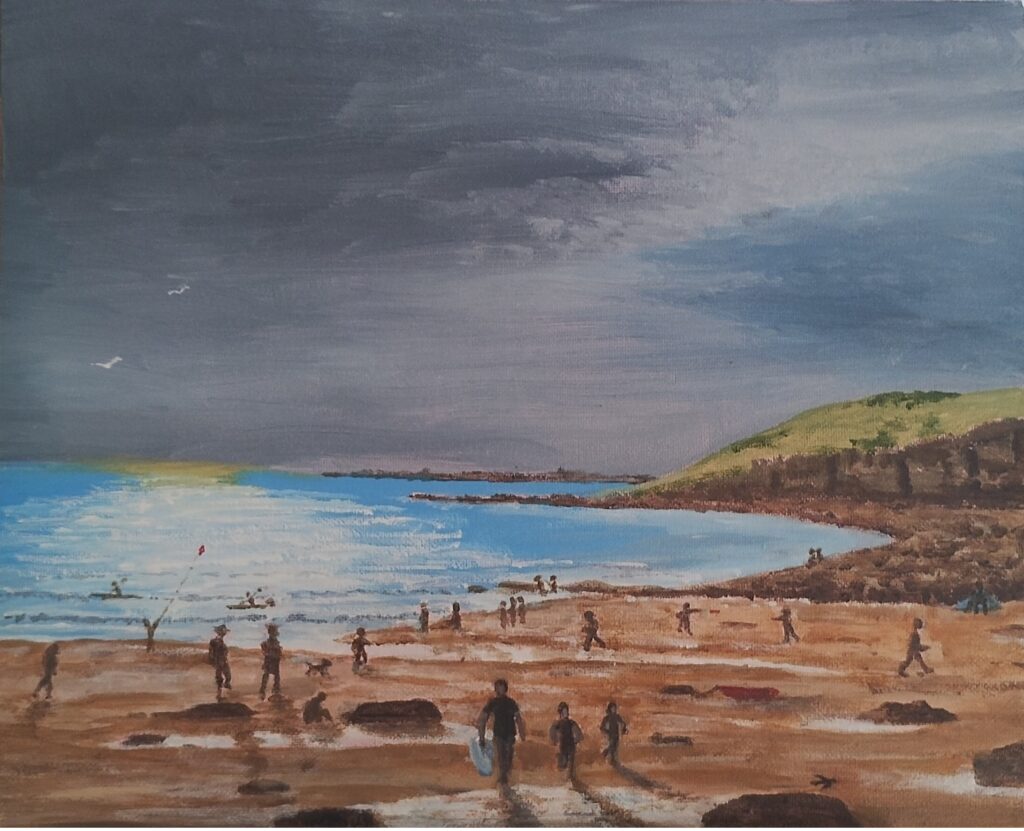
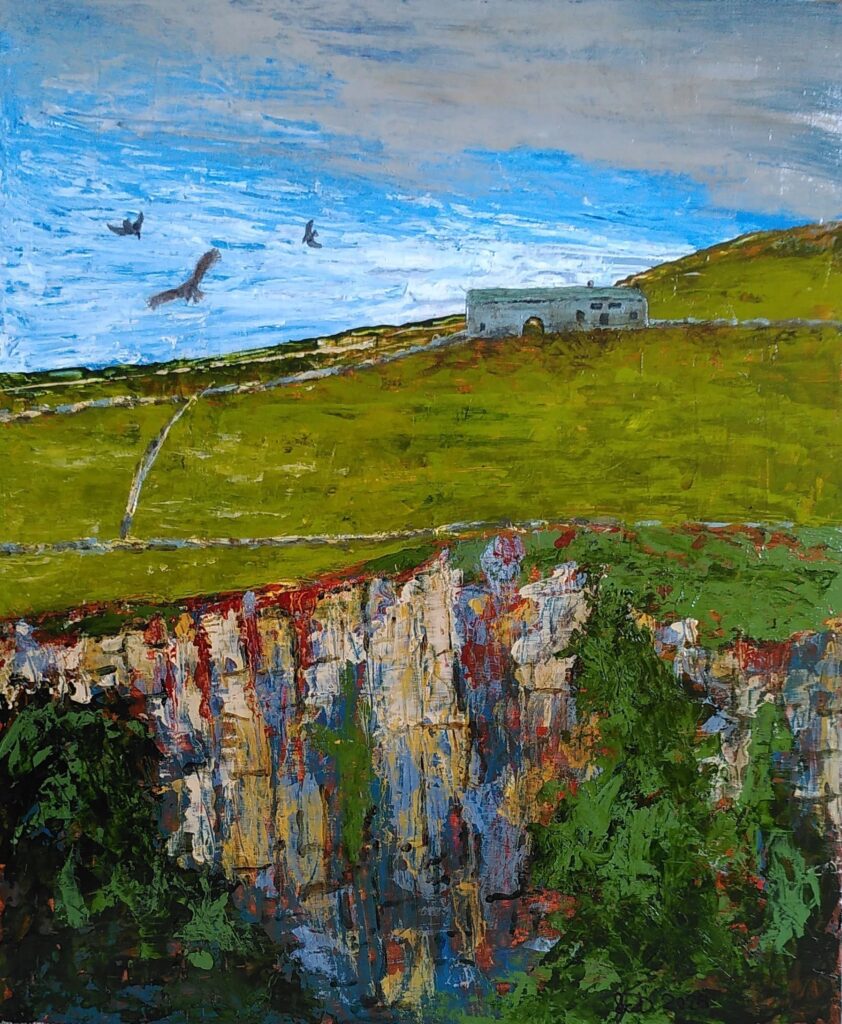
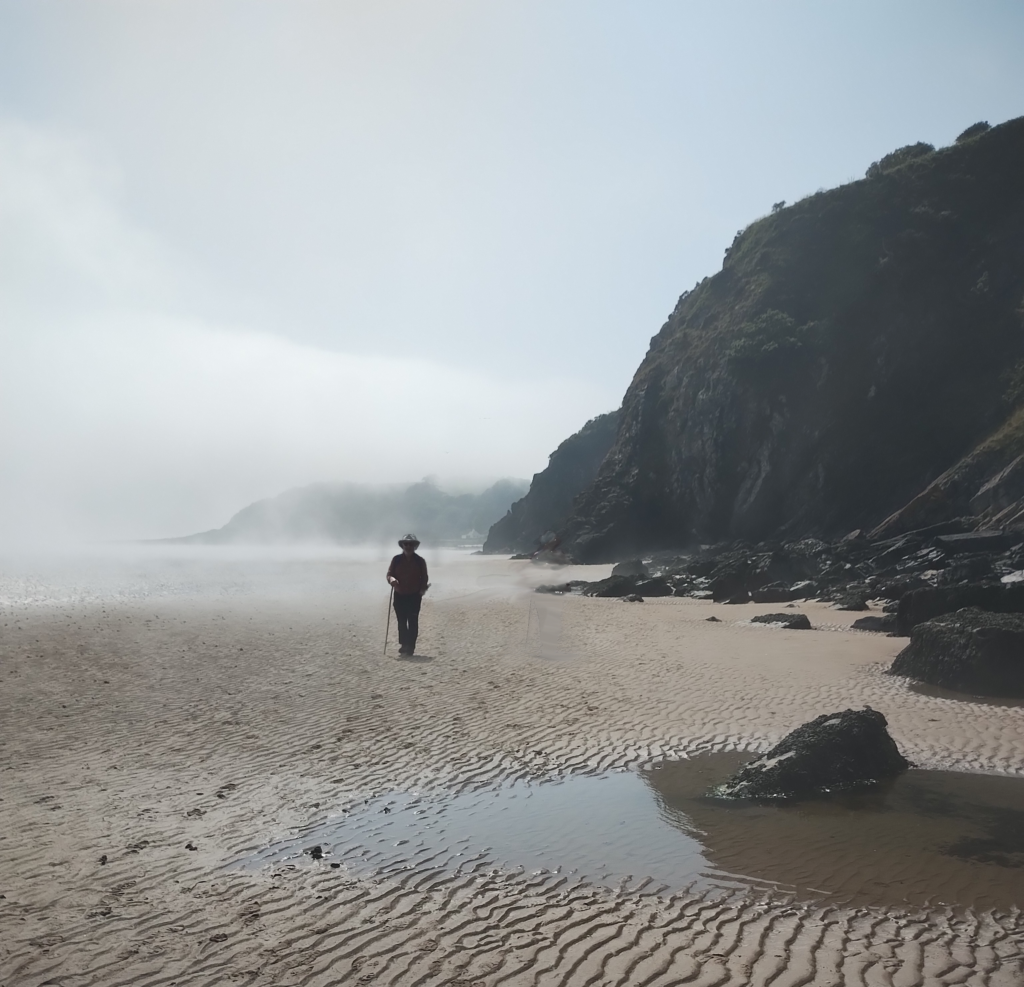
Dunraven Day End
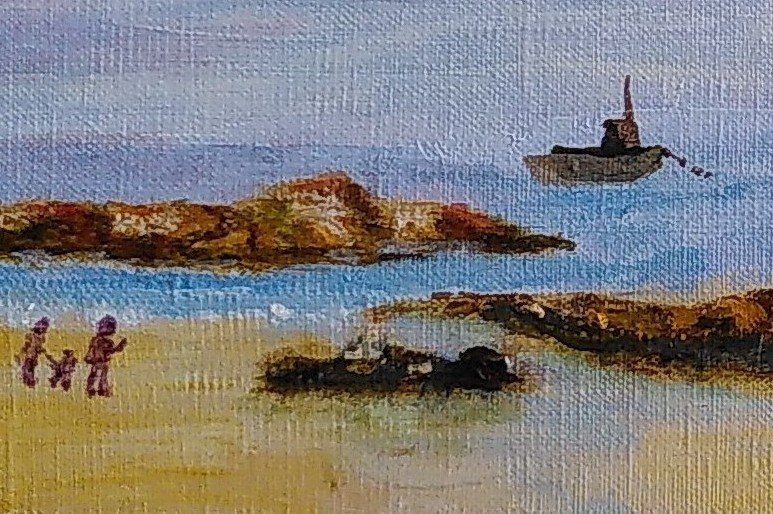
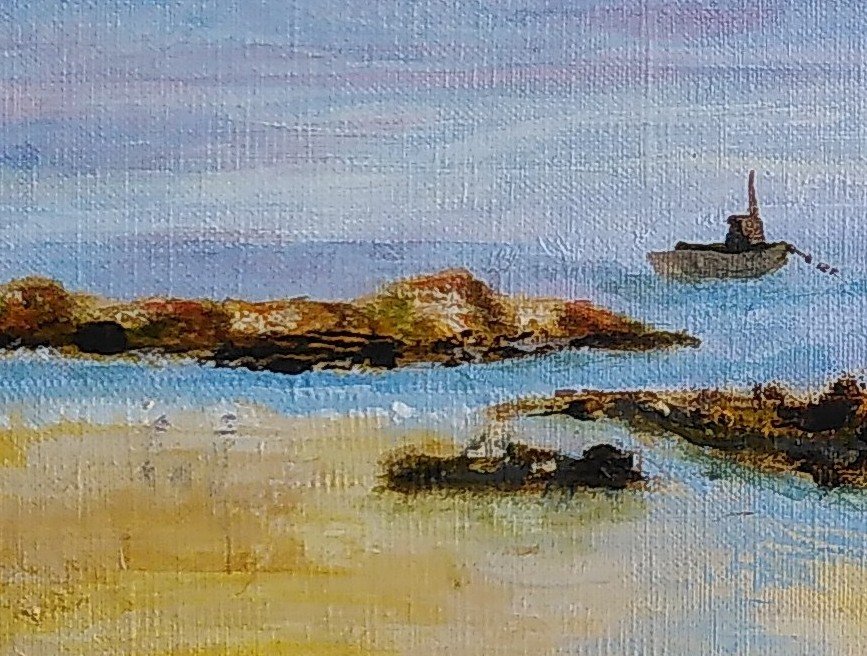
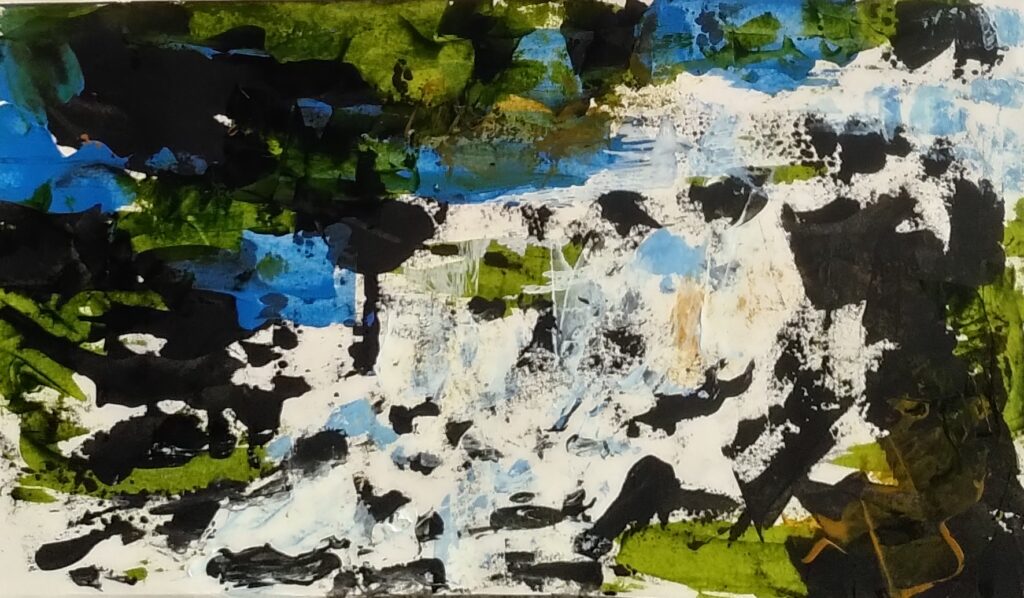
This a a more recent one and reflects some of my present day habits. I made a sketch on the spot and took some photographs. I made some mini sketches of what I wanted to include. The background cliffs are as near the original sketch as possible to capture the day and then the rest was added trying to capture the mood of the whole day, including packing up to go home. By the end of painting this I am no longer looking at other images, just at the painting and whether it is satisfying in itself. For complicated things like little figures I might try out brush sketches on a separate surface, like the paper covering my desk. This allows you to develop quicker and more effective brush strokes.
Desk Sketch
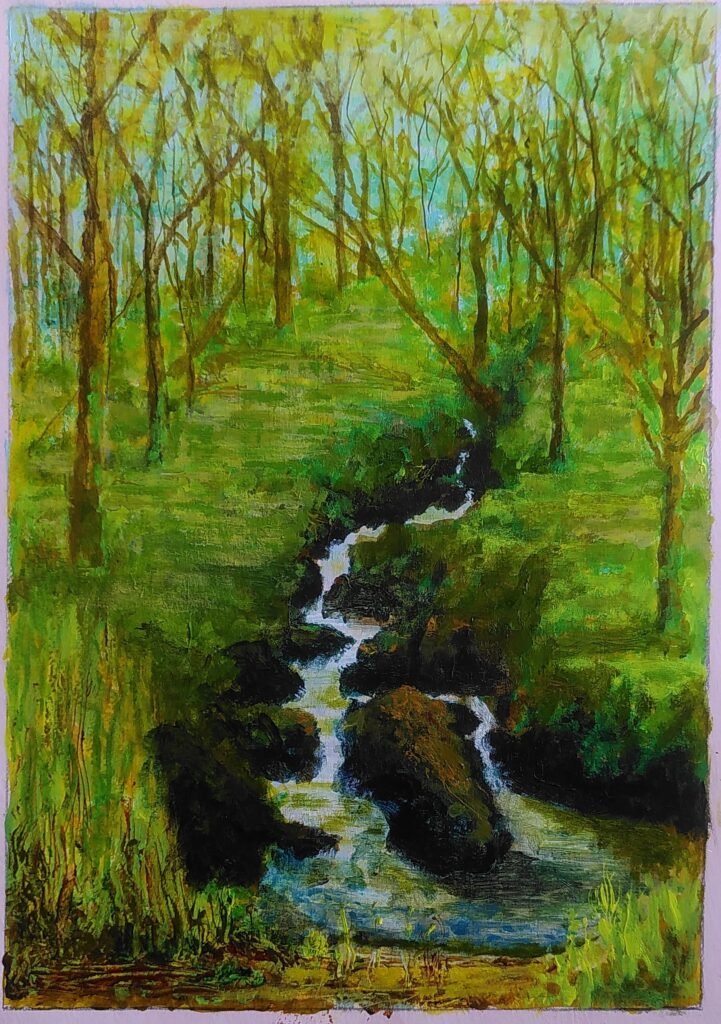
Those examples are all social scenes, which are particular difficult to capture. There is nothing ‘wrong’ with my first effort but I hope you can see that constant development allows me to have more choices and better control over what emerges. As the years have gone by I have managed to get less trapped in the picture or thought that I am working from and this allows me to have the creation of the new picture clearer in my mind. It allows me to stare at the picture and decide where it needs to improve and the best way to do it. Here is an example of a landscape. It is a second development from a sketch. The first development had a family group and a Highland cow on. I decided to do without the cow this time but quickly added the people in. Staring at it made me realise that they didn’t add anything worthwhile so I just painted them out.
Below is a painting from a completely different ‘theme’, one that probably suits my own thoughts and way of working more readily, but all the same I could not have achieved it without applying lessons learned from others and the experiment and development that went before it.
I hope you will keep going and find ways of working that suit you.
Since I started with Shelley Art Group I have tried to make a habit of writing up any learning sessions we do. I’ve just realised that an early one on with, Heather Burton, using these knives slipped out of my brain. As I now use these tools on most of my acrylic painting I thought I should correct that.
At the workshop I just felt out of control throughout but there was something about the freedom of it and the way it created interesting textures that made me persist. Here’s one I created just after the workshop:
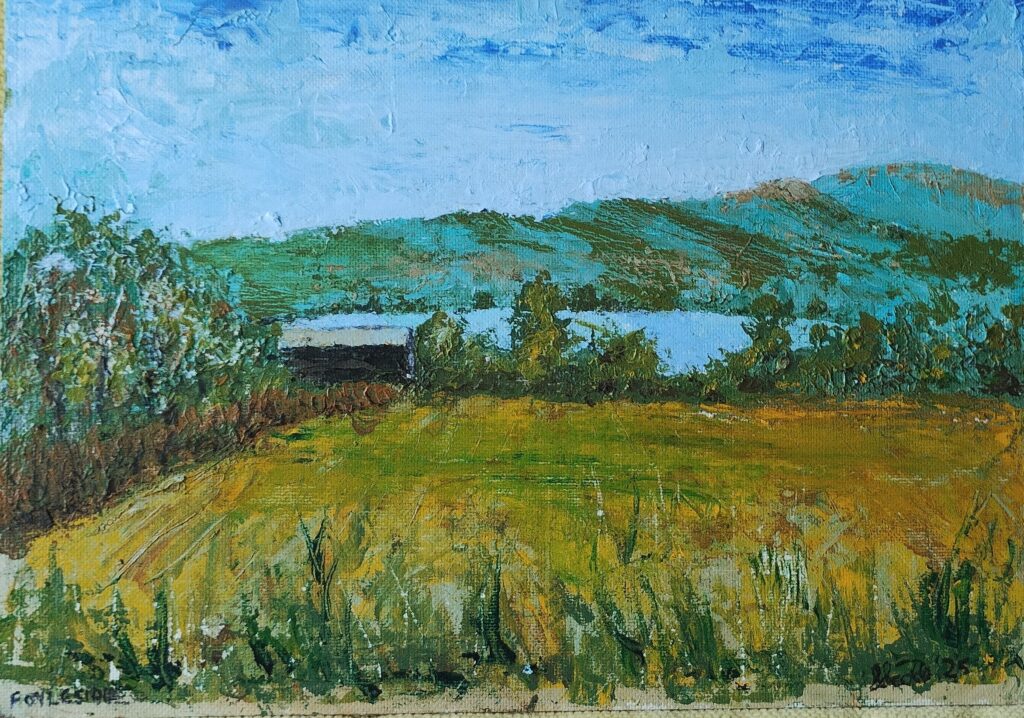
Foyleside Farm
I based it on a sketch I did some years ago and it was successful enough to hang in the farm and to encourage me onwards.
One of the other members at the workshop (Julie) persisted as well and I ended up buying a painting she made. Her descriptions of some of what she’d found added to my store of knowledge. I experimented a bit more and decided to go on a workshop at Heather’s house. Here’s what came out of that (with a lot of work afterwards too):
Digley Airshow
Hopefully you can see that the skills have come on somewhat. Here is a fragment of another.
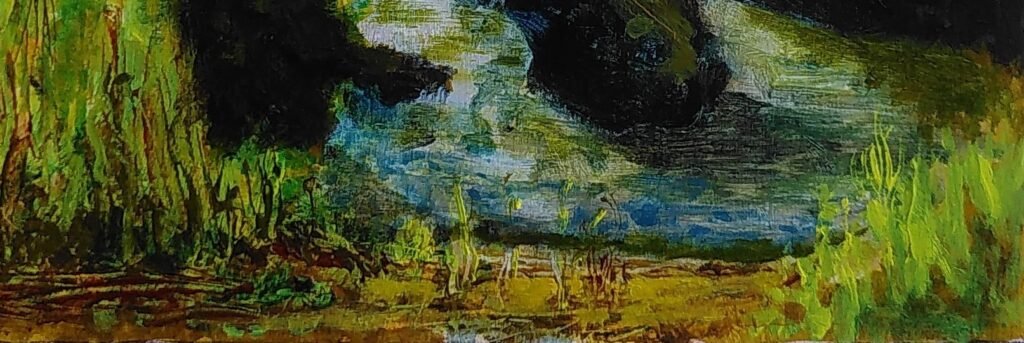
Wood of Cree fragment
That fragment shows the sort of textures, lively colouring and sense of life and movement the pallet knives can give you. You don’t have to use the knife for everything but it is a really useful tool. This post explains some of the techniques, hints and tips for success.
The first tip I picked up from Julie was to make sure you make a good base surface before you start. You can use a heavy paper or board or canvas but also make sure you give it a good gesso base coat as well.
Like me you may associate pallet knives with thick paint layers. You can try this but, like Heather, I recommend that you start with flat layers. If you leave raised or ridged areas it makes subsequent layers much harder to apply. You can layer paintings in a quite traditional way even with the knives.
Related to the thin layers is the fact that you can scrape paint off as well as put it on. If you make what you think is a mistake scrape it off. Don’t worry if it doesn’t all come off. You will have the most success if you embrace freedom and experiment. If you are used to very neat layers of paint you can let the paint dry and paint over but my next tip means that you don’t have to do that.
Instead of mixing exactly the colour you want and laying it on carefully on the canvas or as a thin semi transparent layer over another colour, you can part mix the colour on the pallet and then play with the mix on the painting. You can scrape areas out with the edge of the knife to create lines of colour variation. Look at the fragment and I think you see evidence of some of this.
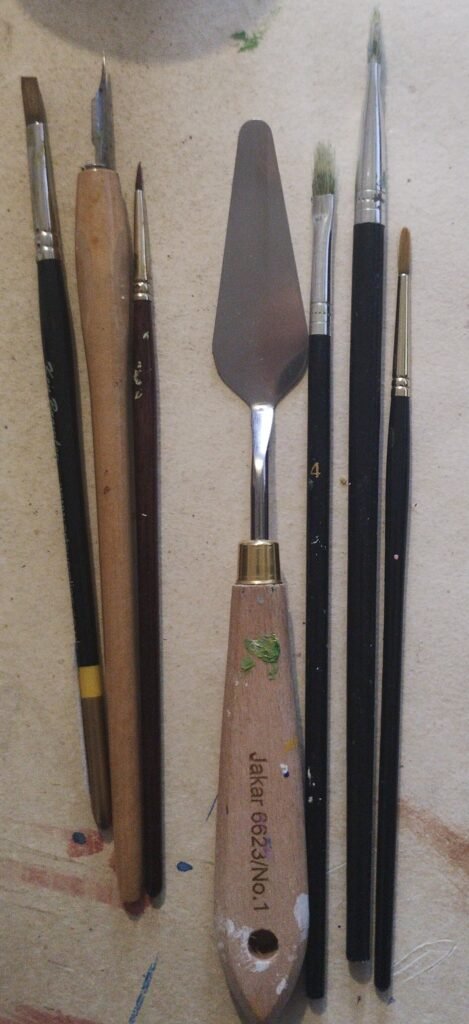
Tools for painting
Less a thicker bristle brush, the picture above show the tools on my desk from a painting I recently completed. The dip pen is for thin acrylic ink marks.You don’t have to stick to one tool. I might apply paint with a knife and then decide a bit more subtle merging is required and so. go over it with a dry brush. Or you can do it with a damp brush to get a smoother effect. Forget the rules and experiment. The pallet knife above is part of a cheap set. They need to be flexible. I have bought a couple of slightly more specialist ones but I don’t use them much. I have usd edges of card to make thinner marks too. Make sure you have old cloths at hand. One of the lovely advantages of pallet knives is that you can simply wipe them clean, though I usually see if any spare paint mix can be used elsewhere on the painting as well.
When applying the paint, pick some up with the knife and apply it to the surface edge first and then drag across, slowly flattening the knife to apply more paint as you go. Don’t worry too much about it. You can pick/scrape paint up if there is too much. Remember you want to leave a fairly flat surface at first so pick up ridges in particular unless they are an intended part of the final painting.
Look at the quarry in the Digley Airshow above. Heather suggested making the marks vertically and that has worked. Any texture in the paint aligns with the nature of the object you are creating and gives a more marked contrast to any marks in a different direction.
As Heather just replied to me, remember not to give up. As I wrote in another post, you have permission to play. Keep going and I think you will find a freedom and a range of techniques that work for you.
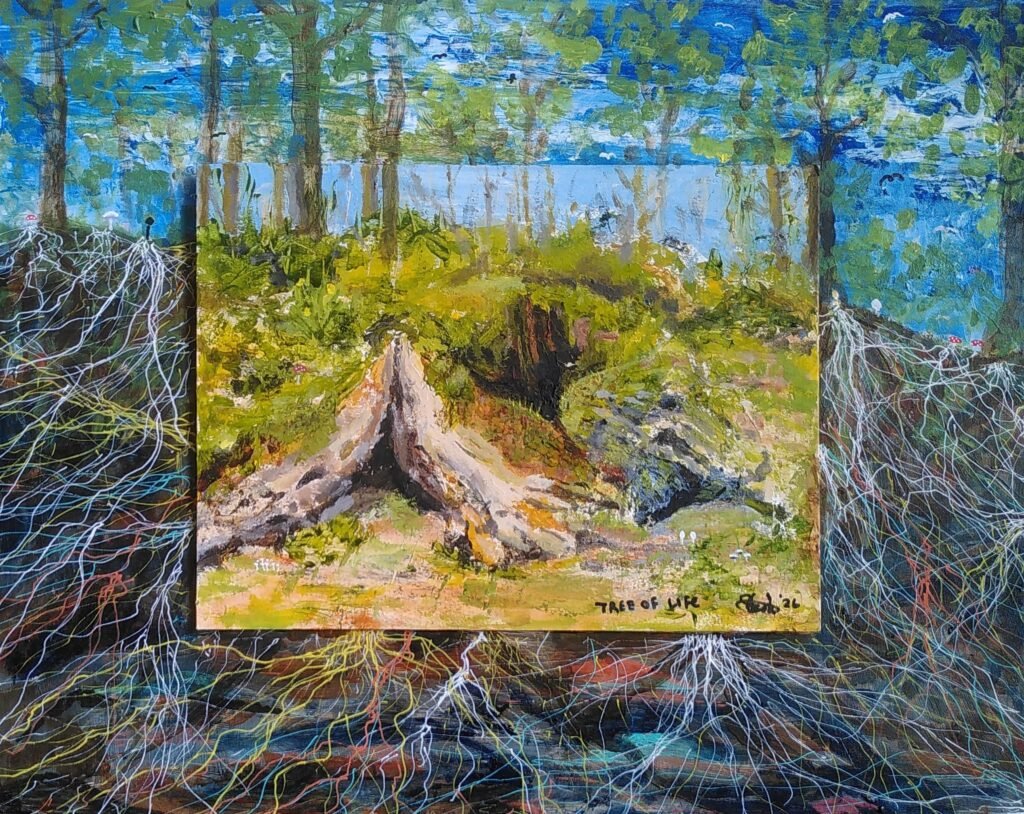
The full Wood of Cree painting using the illustrated tools:
That’s it for the moment. My ageing brain is shouting at me to stop. I’ll come back for more another time.
Early in my life I heard the story that the ancient Chinese worked out how to make a jug spout that didn’t dribble down the side. That may or may not be true but I’ve been amazed how many jugs still get that wrong. I’ve used it as a guiding principle throughout my life to make things that actually work. I also try to help others get the knack too.
Unfortunately we humans keep changing things for change’s sake and often produce ineffective products. A couple of years ago I bought a nearly new electric car. Like all modern cars it has ‘safety’ features that well meaning public bodies impose. I soon realised that the safety features were inadequate. For instance the car might attempt to pull you towards a parked car because it had spotted a white line approaching on the other side of the car. Even if it didn’t actually attempt to steer it would peep at you, unless you indicated your minor manoeuvre. While I am a driver who respects the needs of other road users, there is no need to indicate when there are clearly no other users in the vicinity. Also in some situations indicating is actually more confusing for other users, for instance when you are also coming up to a turn that you are not going to take. The car simply does not have the ability to judge the situation as a whole.
That lack of ability to judge led to other worrying decisions by the car. Both drivers had situations where the car suddenly did an emergency stop, much to the consternation of the driver and following drivers. The car quite simply misjudged the space available round the car.
The car also gets very confused by speed limits and what type of road it is. Again this has led to at least one occasion where the car violently swerved towards a car being overtaken because it thought the driver was was moving onto the opposite carriageway, rather than into an overtaking lane.
The well-meaning public bodies have also decreed that you can’t permanently switch the safety features off. That means that, on a drive with several stops, you have to keep switching them off every time. That would be fine if the switching off worked properly, but on this model of car there are inevitable bugs that mean it either hasn’t actually switched them off or, like ours, it switches one of them back on again when you put your foot on the brake to prepare to move.
So much of this inadequate design now resides in software. and one of the troubles with software is that it is easy to change but less easy to fully test. We have also moved into the age where information is provided to users on the go and in multiple ways. This is used to sell products. Unfortunately, in a car, every moment you are trying to work out what the car is telling you is a moment when you are not concentrating on the job of driving.
In the 1970’s I stumbled into making complex software and also the means of assessing how effective it was. The software I made would look at the roughly formatted information it was given and decide how to analyse it, using other hints from within the information and other guideline information that it had available. It would hand over control to another piece of software when it had satisfied a control limit measuring how well it was doing. If it was not able to solve the problem, it would hand control back to humans, if possible giving them information that would help them sort it out.
When testing the software I would set an arbitrary threshold on how effectively the software would perform and test it against that. If it failed to reach the threshold, I’d look to see if I could make it better but I also did that if it met or exceeded the threshold. Of course I had to set a limit on how long I worked at that before I took it to the other humans to see if that was going to work overall.
This model of software development is just as relevant today as it was back then. The software that controls safety features in a modern car is no different, just more complex and dependent on feedback from more sensors to make decisions. It is particularly important to take this into account when when you are thinking about AI but I’ll get to that another time.
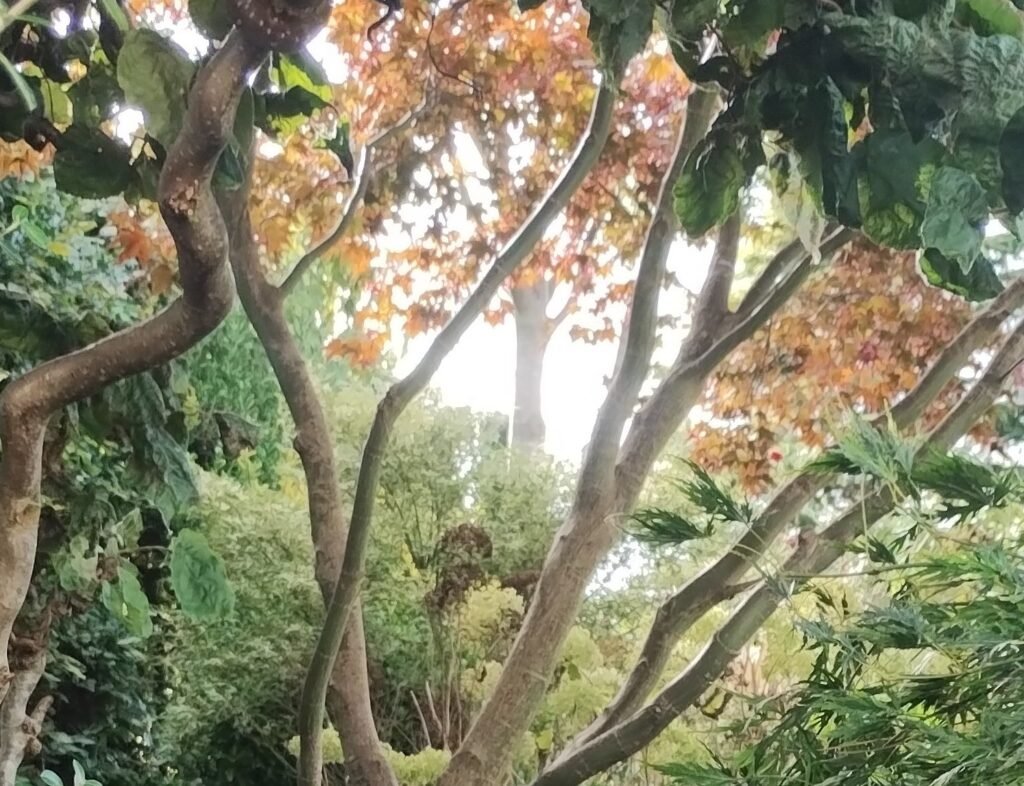
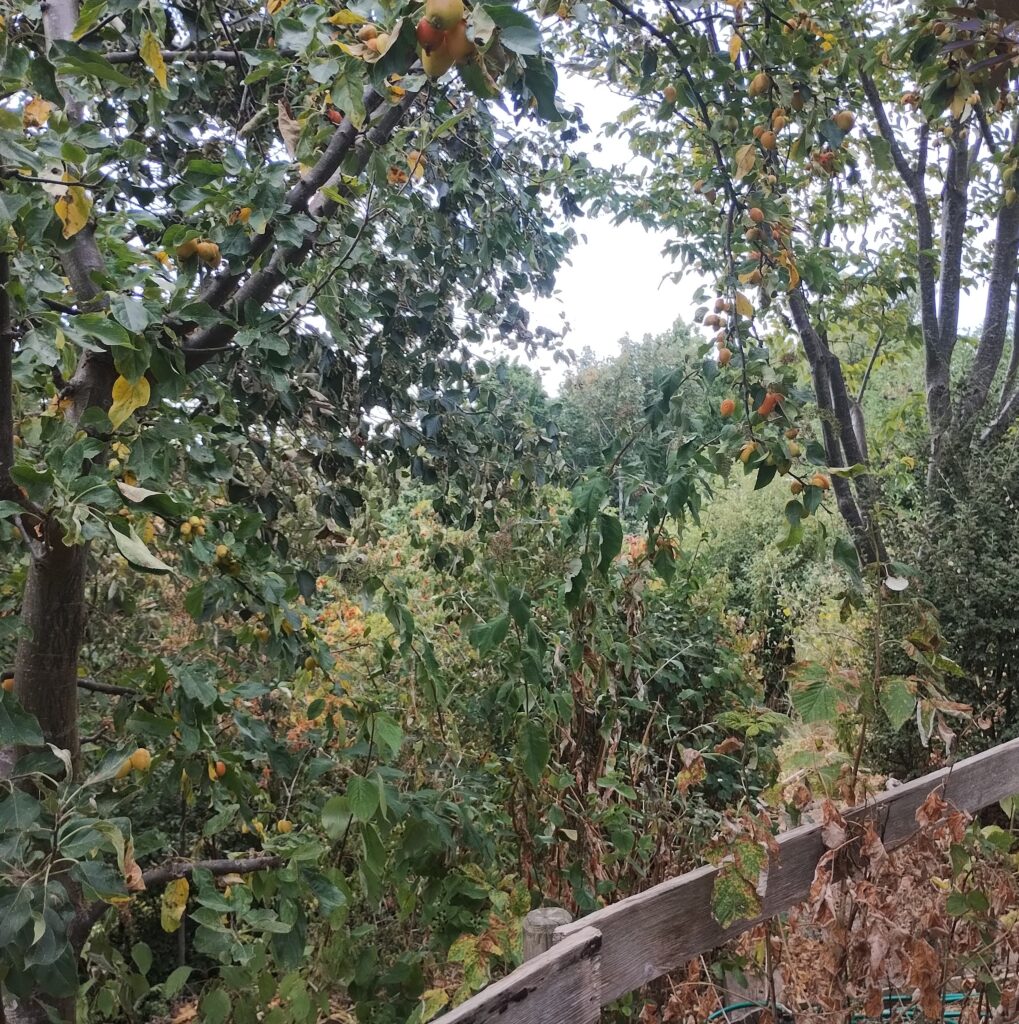
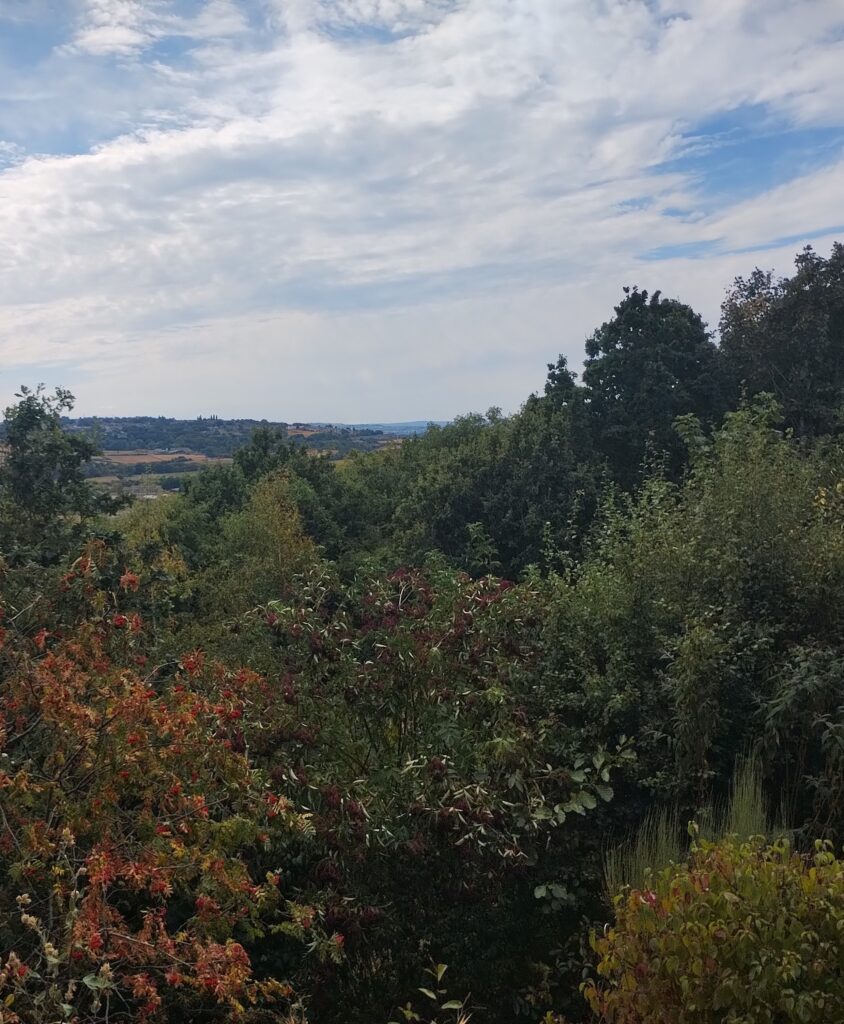
Most mornings I sit in bed with a cup of tea and look at clouds and the trees in our garden. There seem to have been some beautifully different skies in recent times.
This morning I was watching the shape of the clouds move with the wind stream. My child’s brain somehow expected the whole pattern to move in unison but it doesn’t do that does it? What we see as a pattern with some shading, hinting at 3D, is of course multiple clumps of clouds and different heights and distances. They move independently on the air streams where each one is. Everything around us is more complicated than we remember to think.
That’s not all the cloud complications. The sun and air movements change temperatures and clouds can change consistency and even state. A thin whispy cloud might suddenly become transparent and disappear or the opposite. I realised I have spent my life staring at water in all its forms and trying to catch some of its subtleties.
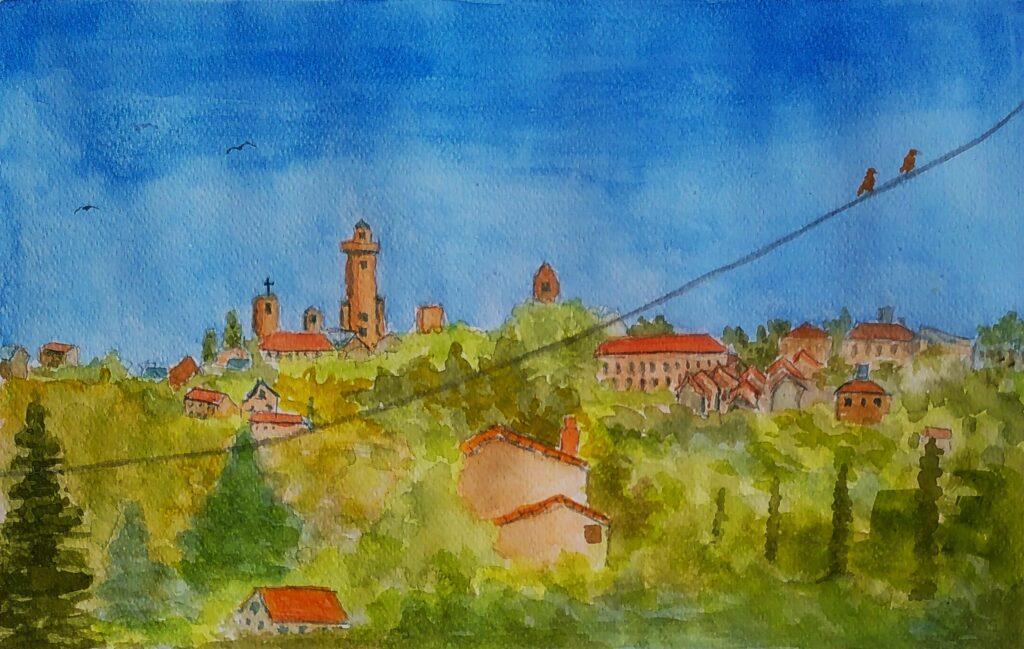
San Gimignano Clouds forming
That reminded me of Elif Shafak’s ‘There are Rivers in the Sky’, which uses water in various ways in the imagery of the story. One theme is the amazing strong electrochemical bond in H2O. She plays with the idea of how long water has ‘lived’ and what it might have ‘witnessed’.
Suddenly I was intrigued by how strong that bond is. First the bond is at molecule level, so an individual drop of water has much weaker bonds and molecules can wander off at any time. That molecular bond is magically strong though and people don’t fully understand it. There are many competing theories and we really want to be able to break the bond efficiently, in terms of energy and cost, so we can unlock the hydrogen. We always want to move on to the next solution. There is a lot of water about but we are not good at managing it. From prehistory on, especially when we band together in bigger groups and let some people get too powerful, we have ruined the useful water in one place and moved on to the next. We are doing it with greater frequency every day. Many improvement are made but they are outweighed by selfish and badly thought out decisions.
Water in various forms
It pleased me enormously to find that the lower half of my window view does splits the water molecules all the time. The plants there use photosynthesis and the power of the sun to achieve the job. I love finding out just how far behind the world we are in terms of inventiveness. We haven’t made a great job with our power and nosiness so far. There will come a point when nature stops rescuing us.
In 1963, one of the first ‘public’ pieces of art I did was a pencil portrait of one of my Grandads. It was realistic, recognisable and admired. It went back up to Barrow with him, was framed and lived on the mantelpiece. It was drawn side on, which is easier, and I have always had a delicate touch with pencil shading. I was just beginning to understand art, what I could do and what I was less successful at.
Since then life has been one long session of ‘if at first you don’t succeed, then try, try and try again’. I’ve always had the shakes, I’ve always had my brain suddenly lose concentration. If I pick up a ruler and start measuring my inability to hold numbers in my head soon makes me lose control. I’ve always tended towards the ‘real’ and away from the romantic, picturesque or theoretical (pointillism, cubism etc.). There is good art everywhere but I sometimes think too much theory loses some of the power that exists in early cave paintings. When I first saw the ‘Arnolfini Couple’ I was entranced by it but I soon became fonder of Bruegel the elder and then onwards into the whole of human and animal expressions of creativity.
Slowly I’ve got a better grasp of what I can and can’t achieve and used that to push the boundaries and increase what I can say with my work. This is the story of one of those explorations.
At our art group exhibition earlier this year, my young friend Georgina put up a work she had done for A level art, based on L.S.Lowry.
I’m not a great fan of Lowry but I also have no time for people who are snobby about his work and if I started listing the artists who I’m not fond of, it would be a long list. Georgina’s painting made me think about how things have changed. I wondered if I could do a version that started in the past and moved forward to the present, where every other person seems to be walking about with a throw away coffee cup in their hand.
I did a quick mock-up and asked Georgina if it was OK for me to use her work as a basis.
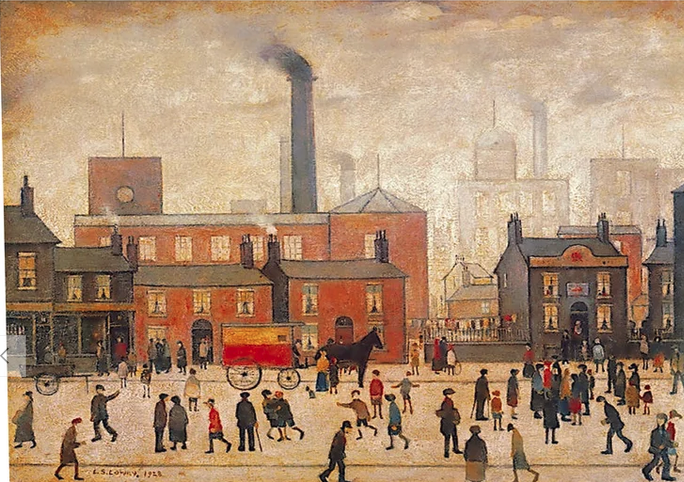
When she said yes, I went and looked at Lowry images. This one is called ‘Coming Home from the Mill’ from 1928.
The first thing that hit me was how much movement and expression there is in the work and how colourful it is. The next was how well-off the scene looks despite the background. It crosses class boundaries. If you’ve ever been near one of those mills, or factories or a big engineering works when everyone clocks off their shift then you will not recognise it in this scene. Next impression was how technically competent it is. Most people would be horrified at the task of detailing so much. Although the perspective is simplified, it is still basically accurate. In true Lowry style, there are no shadows to complicate things and the light and shade is simplified. The surface on which the figures walk has no subtleties of depth and texture, but the figures are placed on that surface and not floating in air. It is not a naive painting. While a Vermeer, for instance, is always masterfully painted, it is nearly always a staged moment in time with little hint of movement. I think the Lowry captures elements of life much better.
I realised that, as with other artists, we often get an idea about someone and fail to look more carefully or ask what their intended meanings and motivations were.
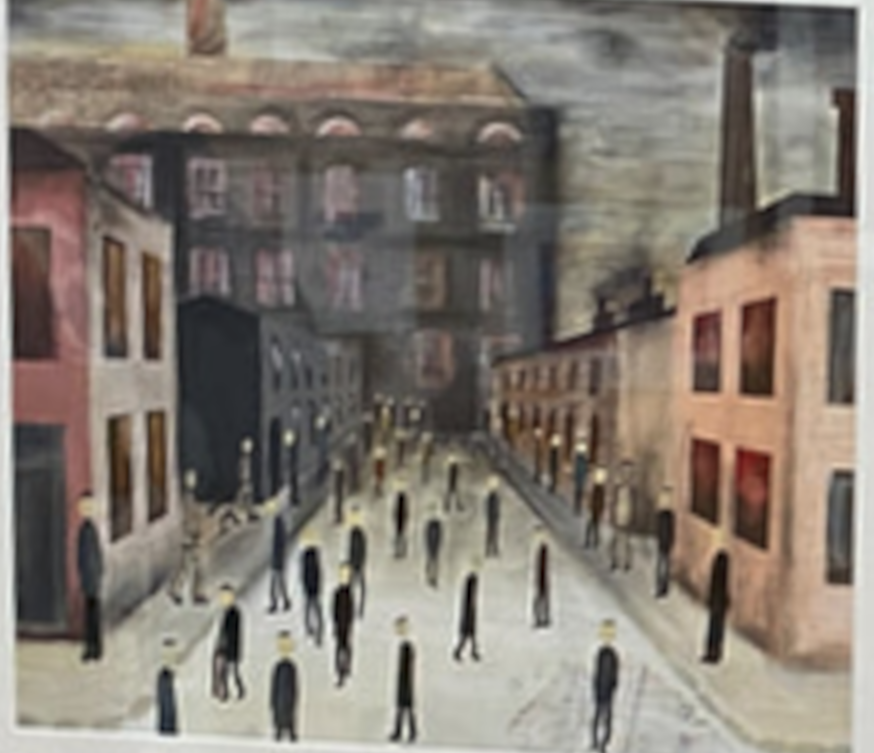
So now we come to my effort. Because of a workshop we did, I decided to do it in watercolour. While I am used to the medium, I do not normally use it for these complicated group scenes. This is the first choice on which the jury is still out.
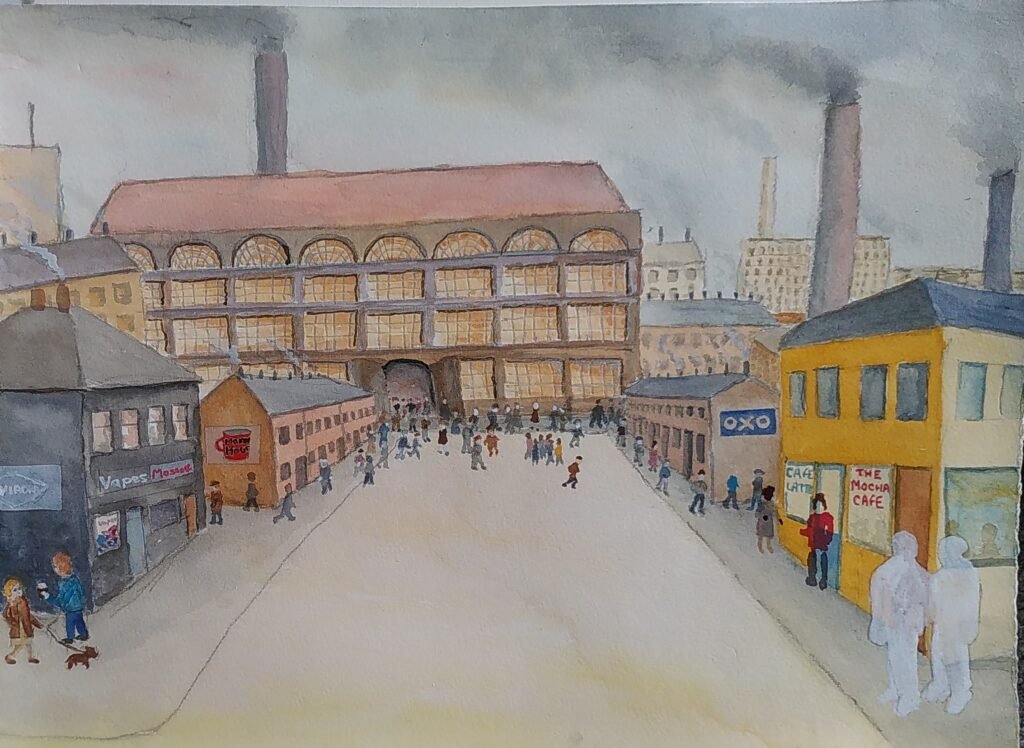
I sketched the background in and left the street much like Lowry’s and light coloured so that I could paint the figures on with less problem.
As you can see, at this point I realised that my perspective was inconsistent and that I needed to paint out the area where I wanted two foreground characters. Art doesn’t have to be a slave to perspective but is helps if your decisions about it look intentional. I decided I might be able to make the perspective thing work. The trouble with something complicated like this, when you are an unreliable and inconsistent painter like me, is that the more you add on the greater the fear of suddenly ruining it. An earlier me would have torn it up and thrown it across the room by now and probably sworn never to paint again. I’m a bit more at ease with my imperfections now.
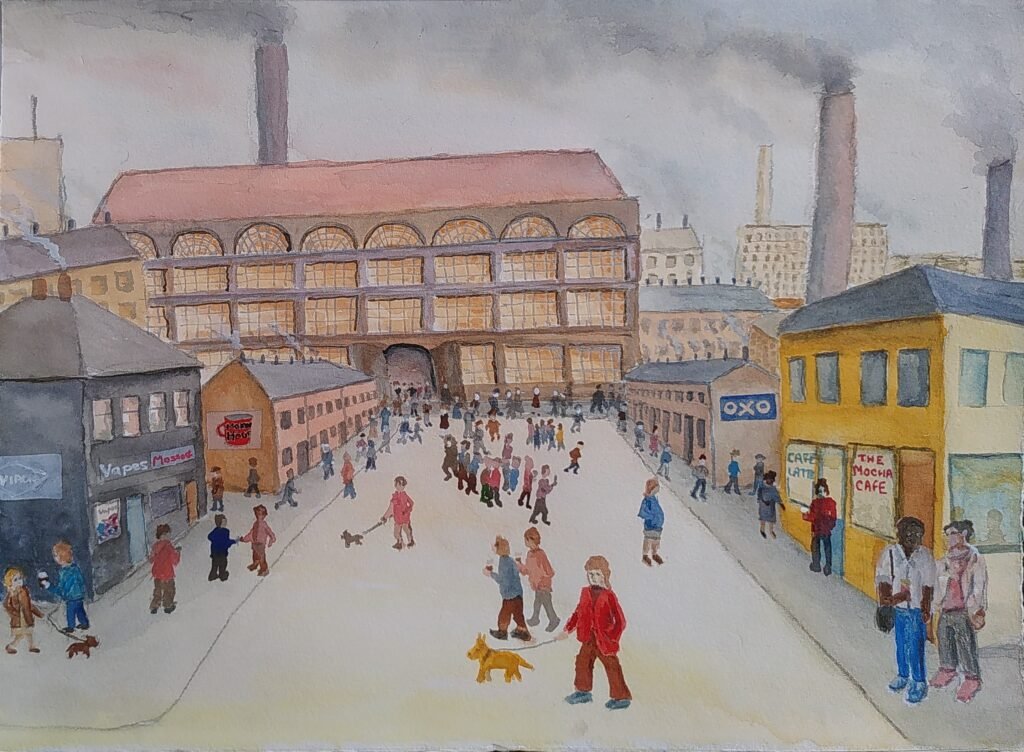
Here is the current state of things:
Call me pretentious if you like, but the idea is that the area near the big mill is the past and time moves forward through the picture. The two wall adverts on the terrace rows are probably more about the time when Lowry died, when instant coffee was in charge and almost no adverts showed men cooking. In the front there are coffees being carried, they have different names, more people have dogs that they can name the breed of, usually somehow related to a poodle cross, and they often expect them to be able to go into cafes with them.
Does it work though? It is certainly not photographic and in my world view that is good. My figures are cartoonish, as they have often been. That is perhaps consistent with the Lowry and I often admire cartoonists. The perspective is not fully convincing but you do feel like you could walk into the picture, especially if you were being distracted by holding on to your dog and coffee at the same time, perhaps while trying to stop your messenger bag sliding off your shoulder.
One of the problems with works that have messages is that they potentially fail if the message is not clear. Could you get the messages without me explaining them? Have I tried to put too many little messages in and lost focus?
As always I can see all the problems in this picture, but I can also see positives in it. It will probably sit around and after I’ve had a rest from it I may spot a way, within my competence levels, to improve it in my eyes. I’ve even managed to improve things years later. I’ll move back to something that I feel uses my abilities better, or that other people will smile at quicker but I’ll keep trying things that stretch me because I’m still learning.
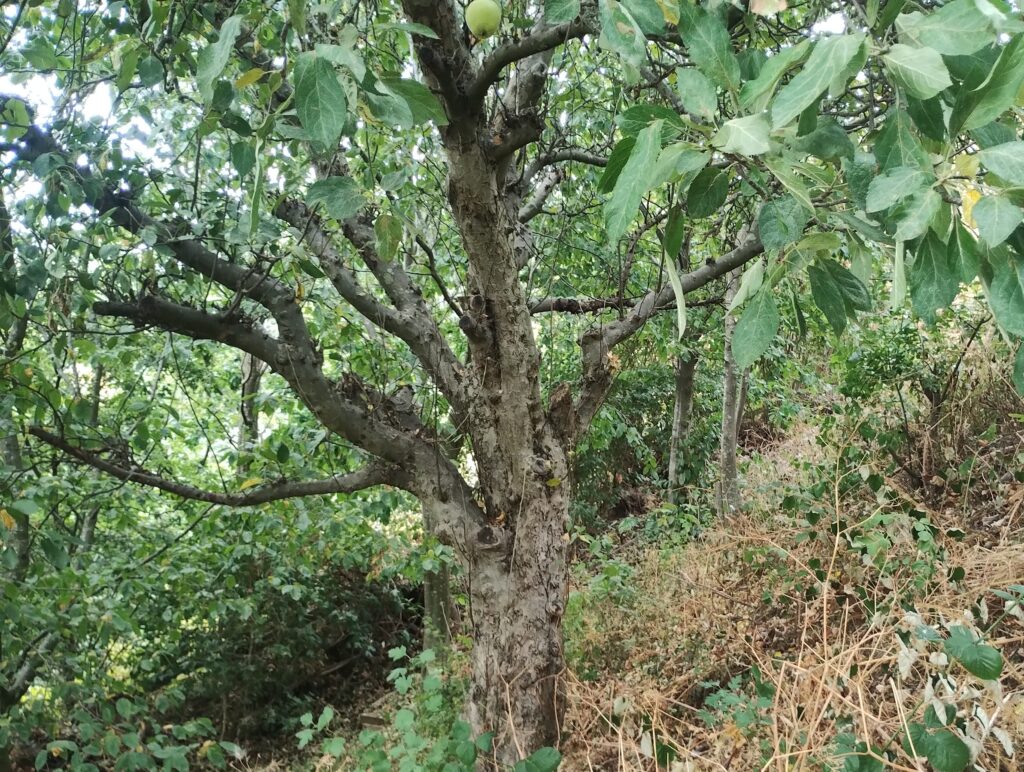
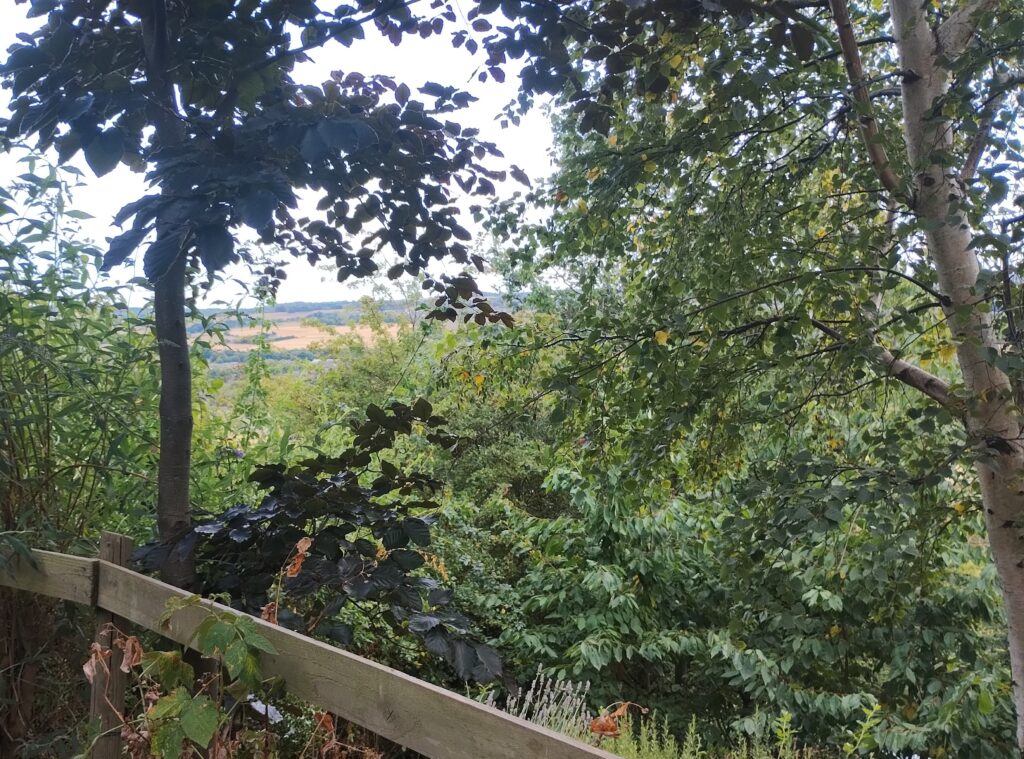
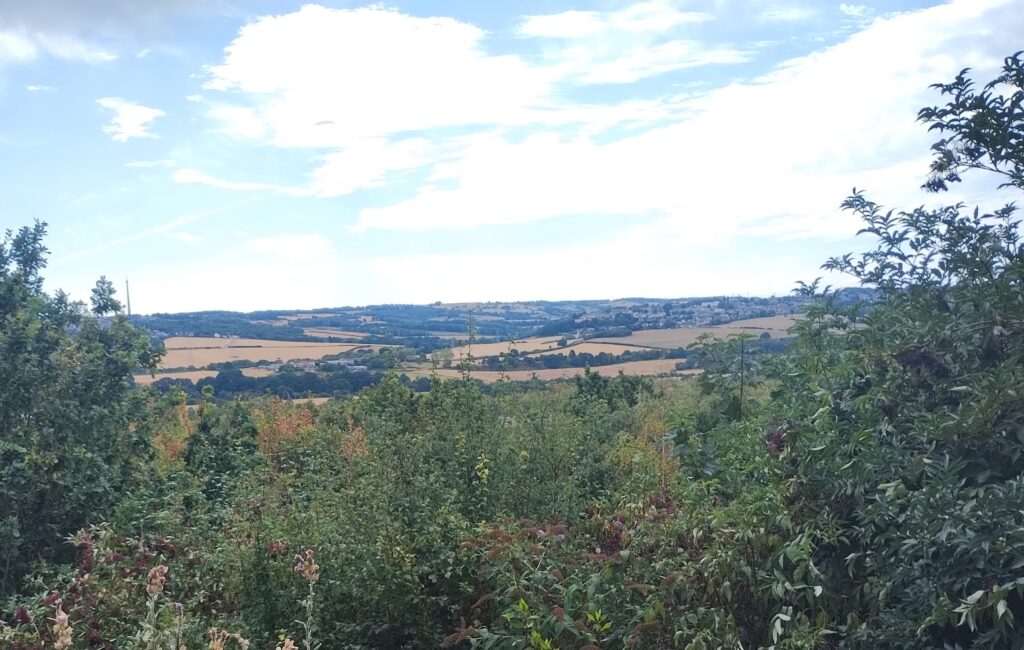
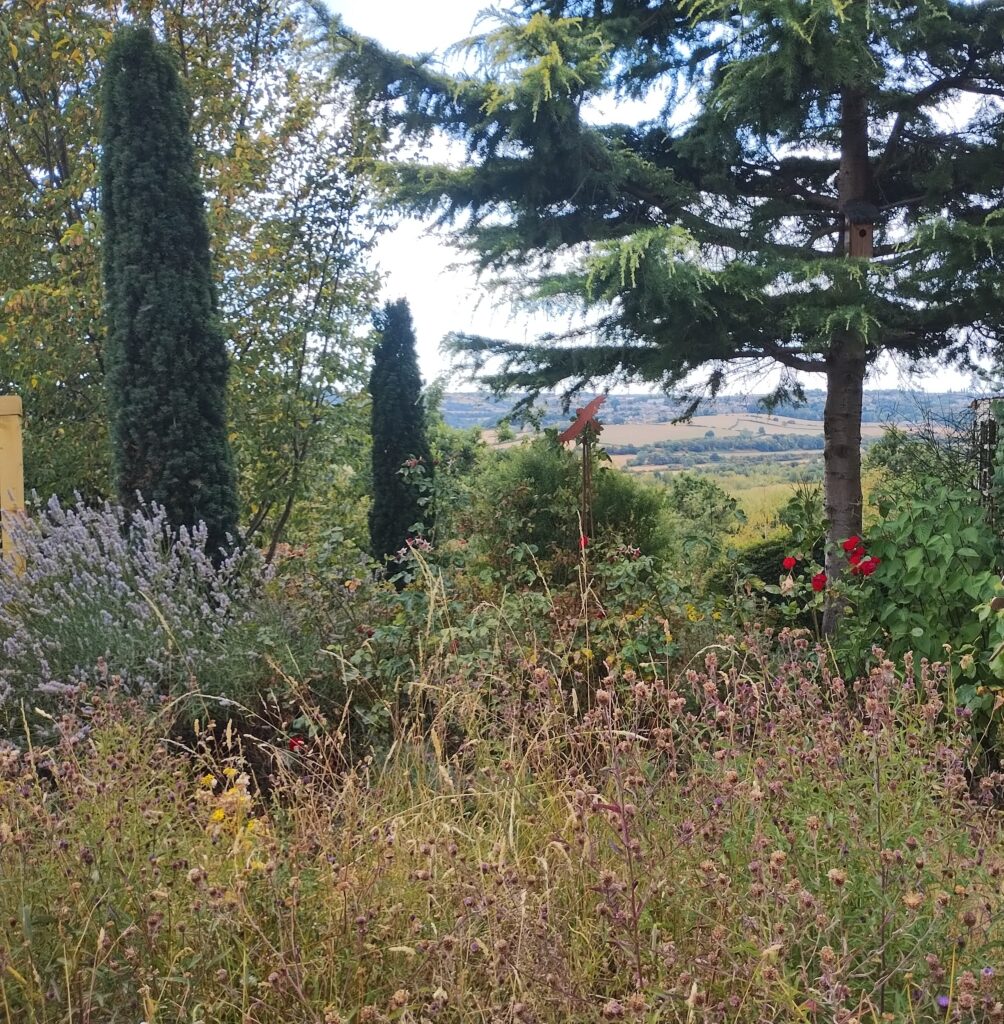
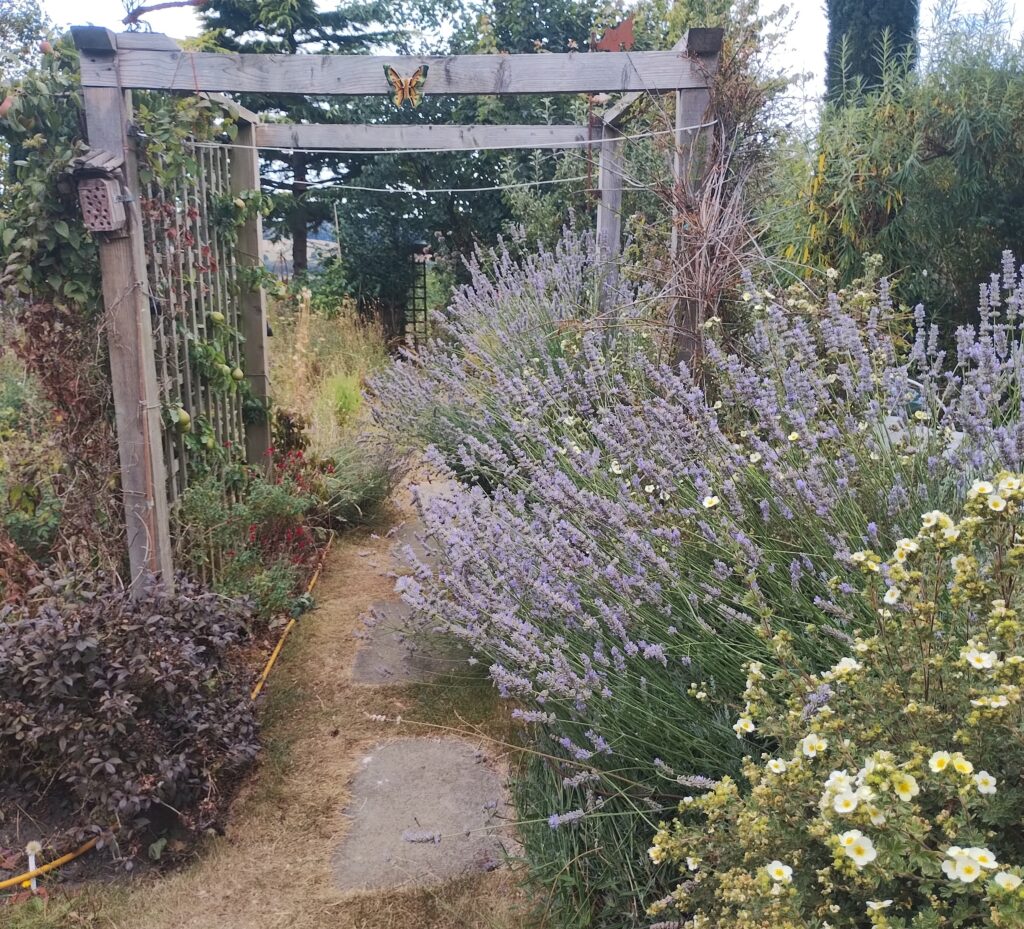
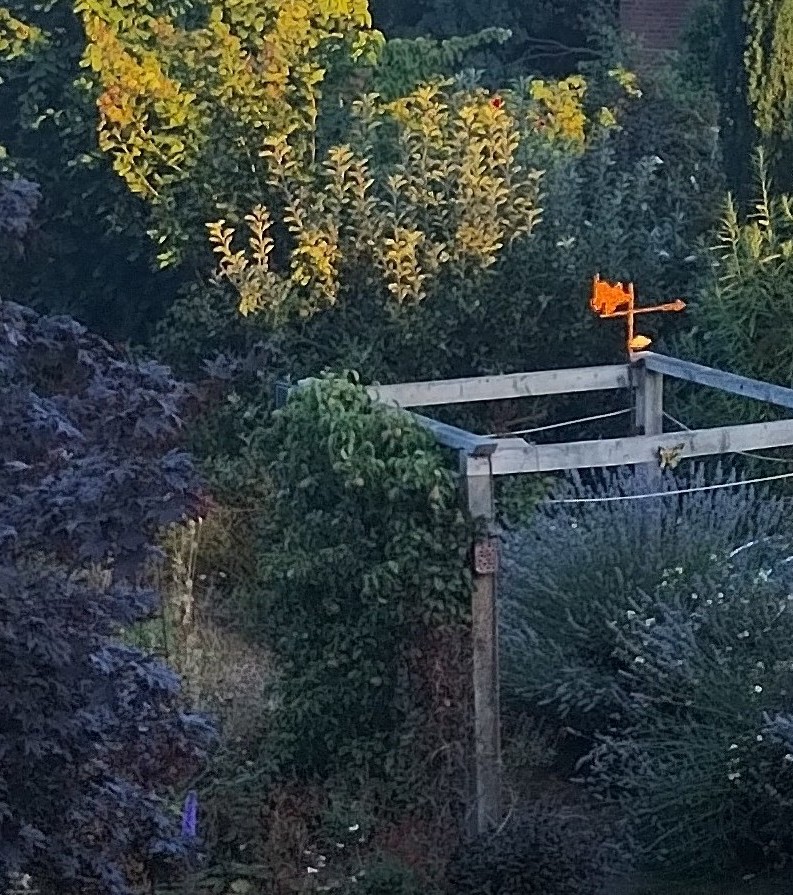
August 2026 and it is dry. Not as dry as the Australian novel of the above title of course. Thankfully we store most of the water off the house and outbuildings and even the grey water from upstairs sinks, bath etc. With careful watering of the newer and more tender plants the garden is surviving. I even throw washing up water on the lawn.
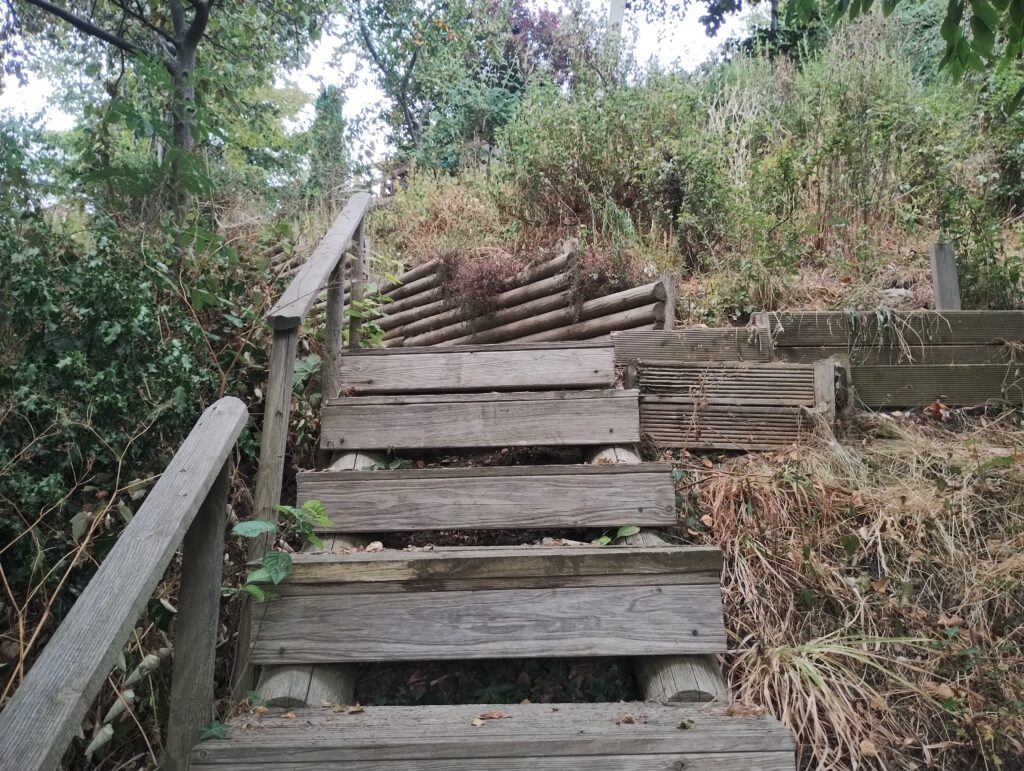
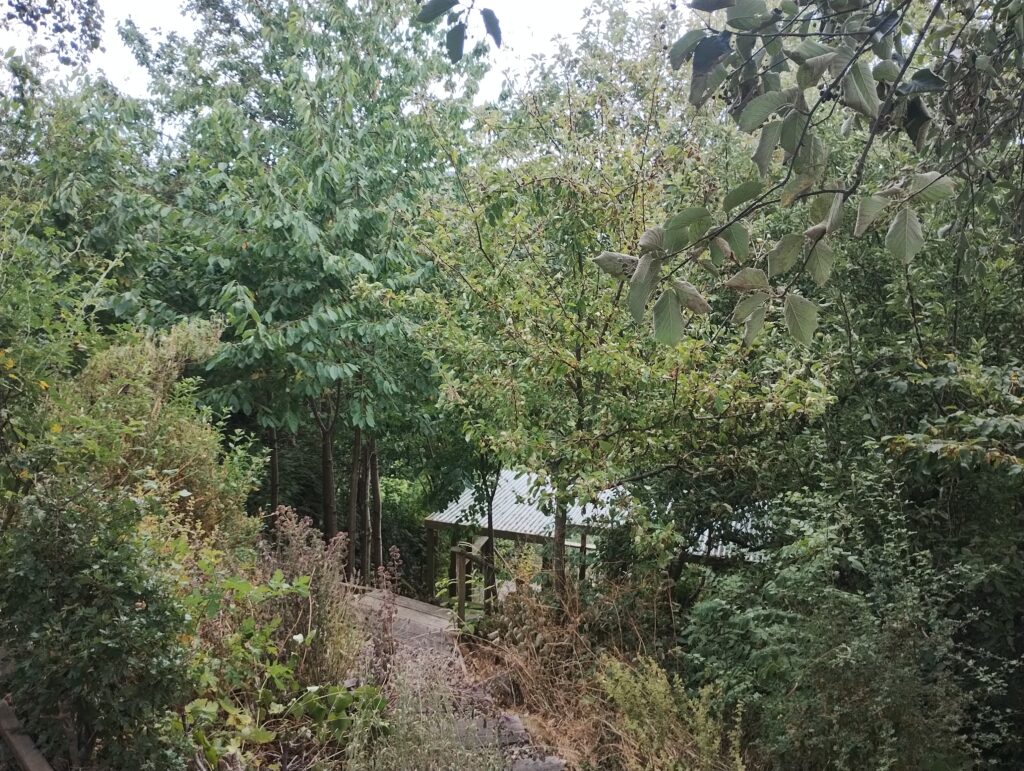
As it is a little cooler today I’ve been out and around the garden sorting out things like a down pipe off the platform roof down the hill, which had got blocked by nest building in the absence of water in the gutter.