It is nearly 20 years since I moved into this house and there were old, unused, nest boxes here then. Those were put up by Ruth who arrived here 10 years earlier. Despite that we’ve put up several since. One was hidden in a conifer about 20m away from where I film with an old Fairphone 3 but just about visible from that angle. Then wood pigeons nested and played trampolines on one of the branches and the following winter snows made a big gap in that part of the conifer.
Still no sign of activity, other than a quick investigation. Suddenly from another room, I spotted a bird going in, so rushed up and set things up. Over several days there have now been multiple sightings. Hurrah.
The first video is the best so far. The second just illustrates the effect of a change of wind direction on temperatures and thus insect activity in early April.
It has turned from reasonably cool to excessively warm and back to cool again in a week. Today has been warm in the sun. After finishing the arch replacement a well deserved ramble to take in the garden’s other pleasures.
Hubris, vanity, ego, whatever you want to call it we are full of it. I certainly have it but try to keep it under control. Weirdly, I came up with the idea for this bit of writing after being irritated by an TV program on cave art. What art is and its role in life is little side interest of mine, and early art is part of that.
The program was about the wonderful and varied cave art at Chauvet. As usual I couldn’t help noticing when the admirable experts and program makers put across messages that were slightly more open to question. We all do that too, making sweeping statements to convey our message more impressively. I went researching and a series of things I came across gelled into something I thought worth saying.
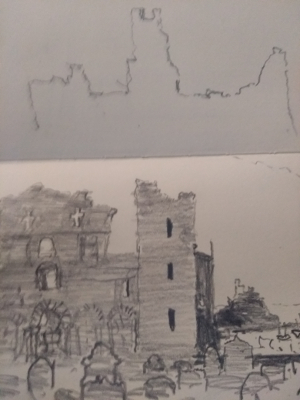
Chauvet Fragment
Let’s start with the art. Art is built into all of us. If you make clothing, personal decoration or decor choices that is a form of art. Current research suggest that people have been making art for around 70,000 years. That is not just us, the badly named Homo Sapiens, but also Denisovans and Neanderthals
Chimp with ear decoration
Art is a form of communication. It is also about display, attraction, entertainment and showing off. Animals of all sorts select objects to show off, make structures to attract, do dances and carry out mimicry to attract interest, sing to draw attention and to ward it off and a whole range of other things of the sorts that underpin all art.
You can discuss forever what makes good art, what conveys more meaning, what is more moral, what is prettier and so on, but it is all art. Likes and dislikes are personal. I really dislike Faberge eggs. I admire skill but there is much in the world that I think of as fashionable rather than admirable and I don’t like fashions and fads in general. Give me a good cave painting any day.
Faberge Egg
In the Chauvet caves there are a full range of marks and techniques. These seem to start at the front end to the cave, with simpler marks, generally in red ochre pigment and range to further back, generally in charcoal and with more sophisticated representational elements, such as lions and bison.
I have to be careful here of that word ‘representational’. It is a word that people load with hidden meanings of superiority in one way or another. People can dismiss abstract art because they ‘can’t see what it is’ or others can equally dismiss art because they (or more often others) can see what it is and therefore ‘it lacks sophistication’.
In Chauvet the work at the front consists mainly of patterns of marks and sprayed hand prints. These are almost certainly earlier and perhaps show less sophistication of technique. The important word here is ‘technique’. Some can be born with a more natural grasp of technique but all can use practice to develop technique. In addition we can also learn technique from others. Human species are not alone in possessing this range of technique development skills.
Finally we come to the question of who did the cave art. I’m not going to speculate on Chauvet because I don’t know. Looking around statements that people make about cave art and relating it to evidence we have about our own development, highlights the hubris contained in those statements, as mentioned in the title here.
Neanderthal Shell Jewelry?
There is suggestive evidence that we lived in the same timescales as Neanderthals and Denisovans for a very long time and that we almost certainly shared locales with them at the same time. Ancient DNA evidence is hard to find but what there is indicates that we share DNA with Neanderthals. How much sexual activity there was we can only speculate on. It is not impossible that the same is true of other hominids. Their development is not completely clear and classification of them is based on the usual, often tenuous, observation of characteristics that we think can be useful in grouping things together or separating them. Taking those classifications and using them to speculate about behaviours, meanings and who did what can sometimes lead to a narrowing of views and options.
What I’ve written so far hides the thorny question of spirituality, which is often attached to discussions of art, archeology and many other things. Elsewhere I have speculated about dogs sometimes going round in circles before lying down. How do they decide when it feels right to stop the circling? ‘Feeling right’ is not really defined by argued logic. That doesn’t make it superior to argued logic. It can’t be explained in a rational way. Sprituality is just one shade of that internal feeling of right or wrong. We need to recognise that what feels right or wrong is fundamental to our existence and therefore needs respect alongside logic and reasoning. As far I can tell philosophical attempts to define right and wrong have always failed to come up with a consistent way of explaining it.
So we are complicated and we are all different mixes of complicated. There is no foolproof way of defining or describing what we do. I suspect the best art contains elements of every aspect of our personalities. It is personal but we can also discuss aspects like the number of layers of meaning in a particular set of work and how well it communicates both layers of meaning and feeling accurately to the rest of us.
Neanderthals definitely made art as I have defined it here. Over time our ancestors developed and passed on all sorts of new ways to make art. I don’t think attempts to judge the sophistication of what our predecessors produced have much value. Trying to use such judgements to artificially categorise and separate us from some predecessor is not very useful. It is the equivalent of colonial assumptions about superiority.
Arnolfini Portrait
Whether layers of meaning and spirituality have increased alongside the development of technique is another matter. Though I don’t believe in vague ideas of spirituality as something outside of us, I think there is often more value in the work in Chauvet and similar examples, on nearly all levels, than there is the Arnolfini Portrait, which was in one of my first art love affairs. I also think that the questions behind what I’ve set out are a good way of thinking about art: Does it make me smile, Does it uplift or move me, does it give me a message, have I learned something from it?
I hope some of the things I do make some people answer yes to some of those questions and I hope I have helped you in both enjoyment and understanding.
Having watched a program on solitary flower bees and having recent logs lying around, I thought we’d give making another bee intended log pile/ stumpery a try. I did manage to overheat a small drill with my usual gung-ho approach. First I had to remove all the suckers from the Hazel, then split some of the logs, then the drilling and piling
The article is both very good and also very bad. As far as I can tell, it tells a detailed and accurate story. Sadly it is absolutely crammed with details and acronyms that are often superfluous to the message. This despite it mocking the constantly changing jargon.
One example is that it prominently refers several times to the acronym LLM without explaining it. The only real reason that LLM is at all relevant is that some commentators thought that the missiles were targeted by a Chatbot. Chatbots use Large Language Models to make sense of the conversations.
As well as cramming too much history and historic factual detail in, the article also cherry picks the detail to take aim at particular targets such as the US and Palantir. The people in those, and other, organisations may well warrant criticism but not as a way of boasting about other’s superiority.
I think the gist of the situation is that there are systems (a combination of technology and people) that provide information to inform decisions about targeting in a combat situation. There are also systems that allow greater accuracy and speed in the delivery of the actual munitions. The technology used in delivery can now be faster, more accurate and can be controlled remotely, either directly by an operator or automatically by a technological system. Some of these systems now include some AI to analyse increasingly greater amounts of data including satellite imagery, mapping and coordinate details, weather and technological capability.
The development argument is that politicians and military high-ups make faulty decisions about strategic developments, often based on ignorance and ego. Even if the actual developers show a conscience about what is proposed, they will simply be by-passed and replaced. I can tell you from personal experience that it takes a lot of resilience, mental agility and a persuasive personality to re-direct strategies in a more valuable direction. The other area of failure in the development of all technologies is that each level of people involved loses interest when it comes to the testing the system against the objectives and also re-examining the objectives to ensure they still make sense.
The usage argument is on several levels. The first is that the more capable a technology appears to be, the less attention those operating it pay to whether it is working properly. The second is that the further away that the operators are from the effects of the technology, i.e. dead bodies and destruction, then the less likely they are to question what they are doing. This distance is even greater for the original strategists and many members of the public. The main crux of the argument is that this situation is not new and people of all sorts fail to pick up the nuances of how it all works and therefore who or what is to blame.
Finally on AI, I have written elsewhere about what it can and can’t do but the main message is that you can’t rely on it in all situations. It is trying to mimic human intelligence capacities while adding much better data processing capability. Donald Trump apparently has some intelligence but, personally, I wouldn’t rely on anything he said or any decision he made.
I hope that is helpful. On a personal level such situations always remind me of the cartoon film ‘Up’. There are some scary dogs and as a pack when one of them thinks they see a squirrel, they all turn their heads in unison and growl ‘Squirrel’. The other thing about those dogs is that, like the ‘wizard’ in the Wizard of Oz, they are really also babies wanting to be cuddled and fussed.
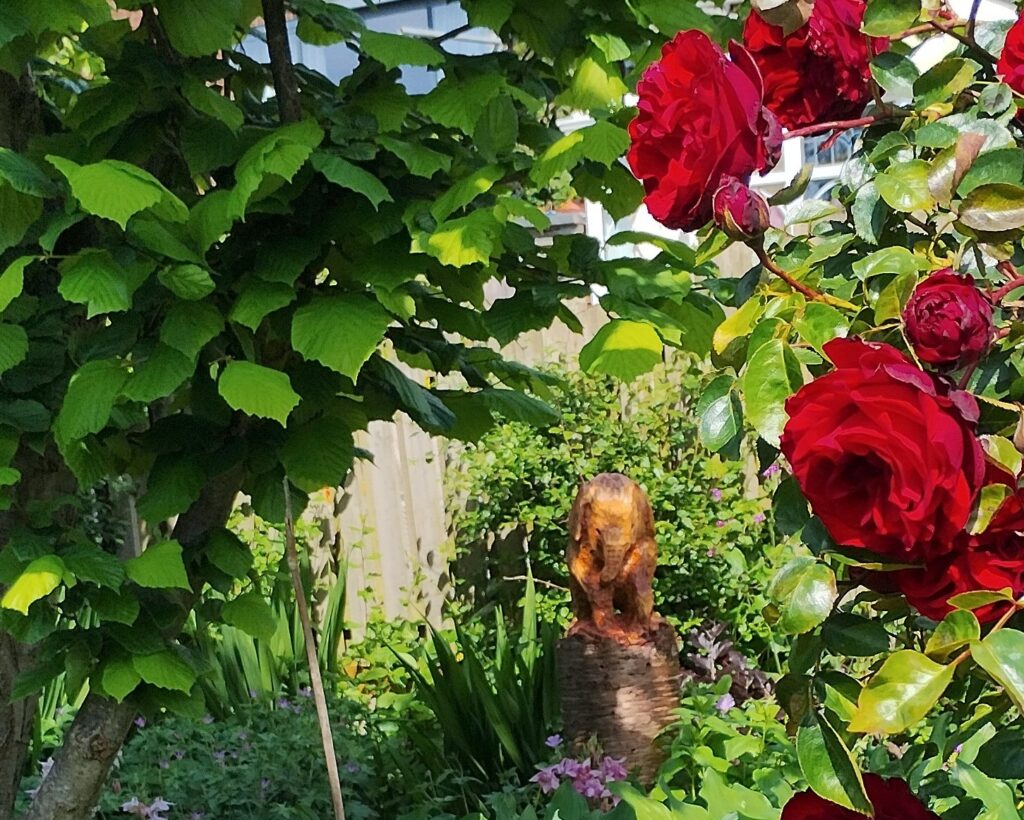
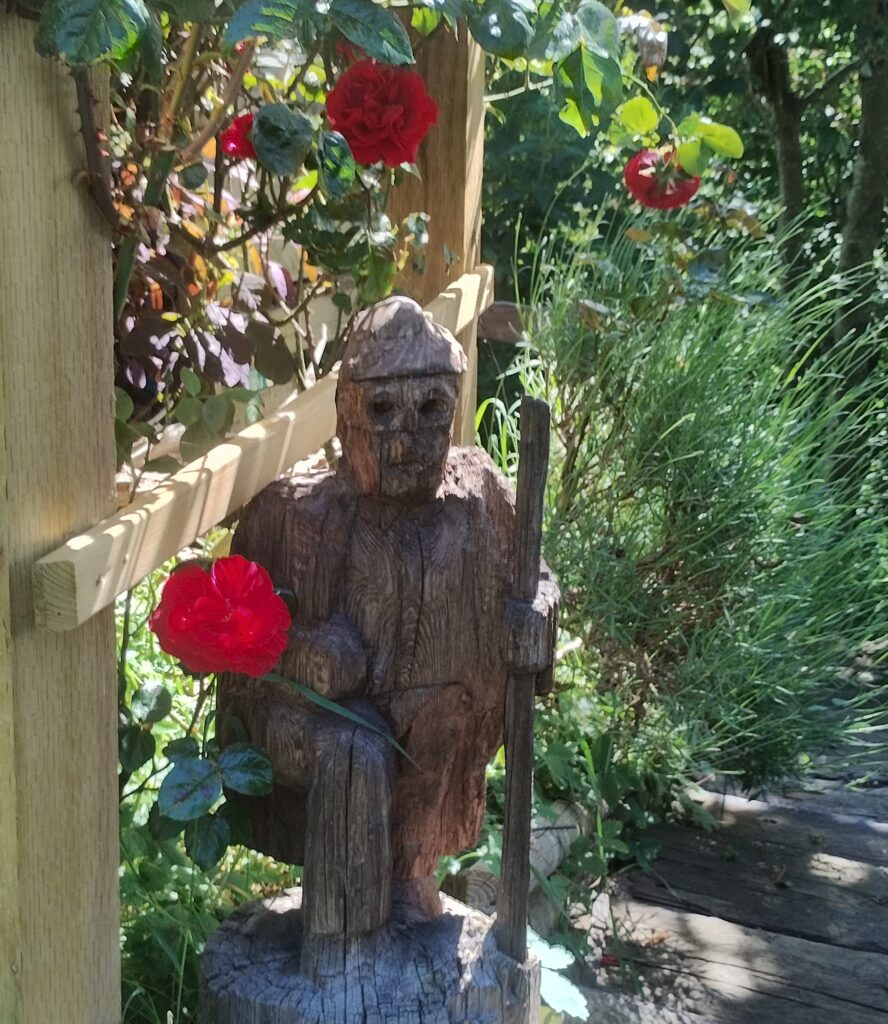
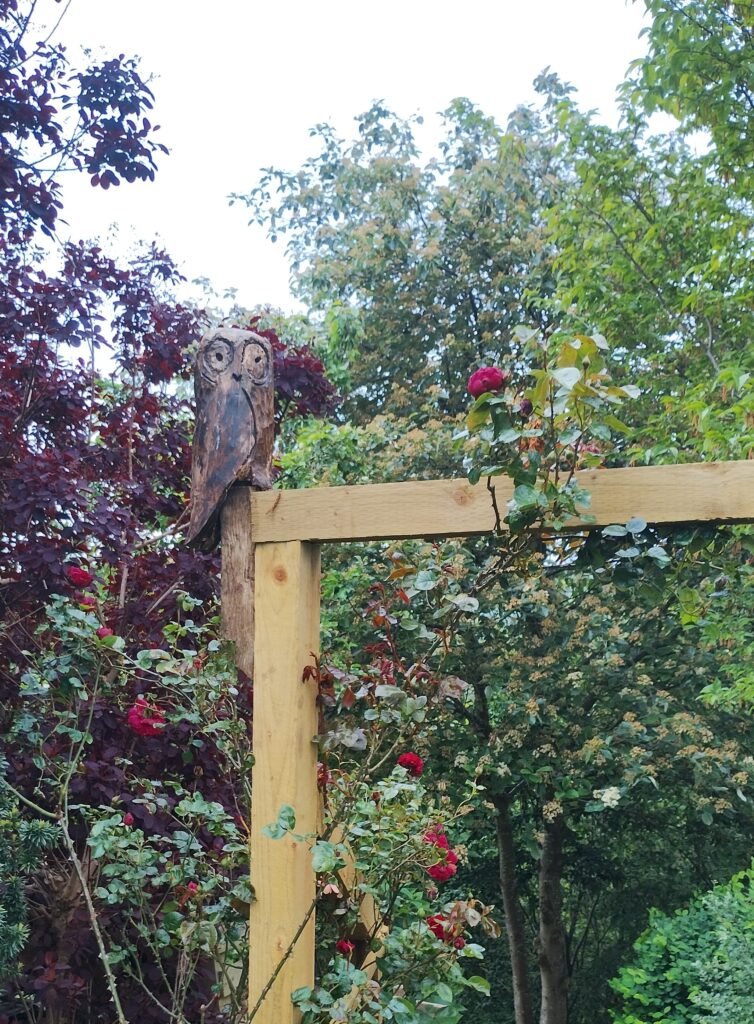
In 2015 I made an arch from pollarded Sycamore branches, to mark the begining of the main steps down the garden. I didn’t expect it to last long. A bit later I added a carved sycamore owl to it. The insects were boring holes in to it already.
2026 and high winds have finally brought the arch down. It has done good service for wood from our own garden.
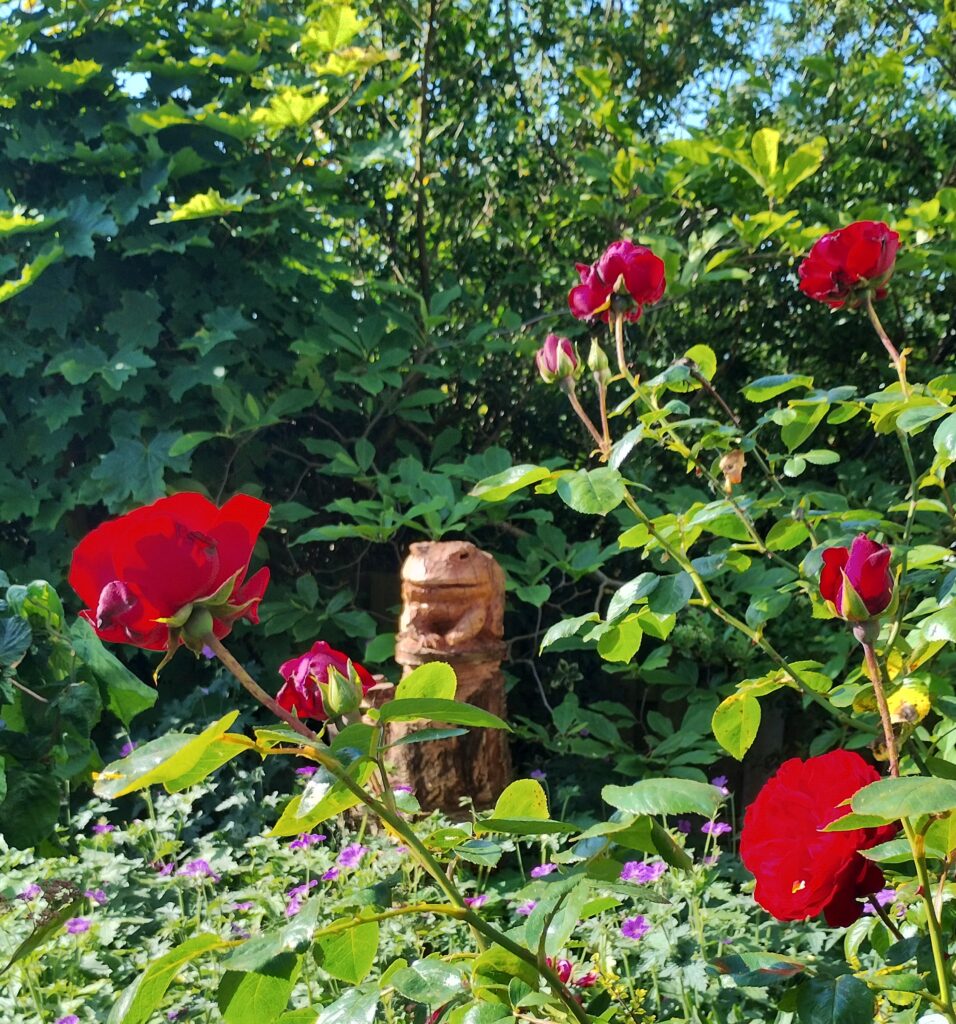
At the same time my latest sculpture project is coming along nicely. Something to smile at till the arch returns. As it is a cherry tree that had to go, carving needs to be done in stages. It is very soft and prone to split at first in parts then dries out much harder. Time to leave it for a while longer and decide how much more work to do when it has dried out more.
Update:
The logs have evolved into a stumpery with loads of holes drilled for bees (and one overheated drill bit casualty) and a slightly less pretty but pretty practical arch has risen up. The roses that collapsed with the old arch will come back and soften its lines. The old wood turned from nuisance sycamore tree to insect friendly arch and will now be reduced to shorter lengths and continue as a wildlife friendly zone. The two wood pigeons in the tree behind the arch fooled me into thinking they were pheasants. Masters of disguise.
Yesterday evening Stacey Shaw gave us a session at Shelley Art Group. This is my attempt to summarise the messages she gave us and to add my own angles on it. Stacey reminded us that it always worth remembering the basics and used some good teaching methods to get across the messages clearly.
We started out with an arrangement of white cube, sphere, cone and cylinder. Stacy asked us to think how we could start to establish the shape on paper.
My quick version of the arrangement.
A quick word on pencils. For years I used 5b and 6b most of the time. nowadays I tend to start with 9b. These soft pencils encourage a freer touch and you can also make them very light as well with practice. A textured paper works well for some subjects but smooth is often better for pencils. Pencils are naturally textured.
The cube has defined lines that give us its shape. It makes sense to sketch those lines in, if only to establish the perspective (if you want to stick to that perspective).
The sphere looks like a circle but we can usually see straight away that it is a sphere. Drawing the outline can help you to make it circular rather than some other shape but you run the risk of giving the sphere an edge. If you don’t trust your shape drawing (who does?) then draw the outline but make it as light and sketchy as you can. The sphere optical edges are defined by where it goes out of our line of sight and where the background objects disappear behind it. You could begin to detail the shape by putting in the background objects.
Both the cone and the cylinder are versions of the sphere but with edges. If you chopped the sphere in two, you would have a sphere with a tricky perspective circle, in effect making it a figure with two faces. To indicate the shape better you could make lines that follow or indicate the shape and that would allow our brains to pick up those hints. To get a more nuanced shape definition we use the light which gives us shading and shadow. Tracey put a light on the objects to emphasise both of these. She also told us to make sure that we were constantly looking at what was actually happening with the shade and shadow and not making assumptions about what was happening. When I came to draw the grouping of objects I soon realised that the light source was slightly rounded, exaggerating the way the light radiates out and both the shading and shadows went in different directions for each object. When the close, directed, light was turned off there were multiple shades and shadows from the many lights in the room. Also the object themselves reflect some light onto other things around them.
Shading strip. Notice the shadows the strip makes and how exaggerated they are
That of course is the simple bit. Tracey quite rightly had a moan about denigrating art in education, when it is actually a very complex subject with multiple technical and social aspects to it. I’ll now try to set out, briefly, some of the other lessons from the session.
Without getting tied up by it, always try to remember that every object that you draw is a shape like these ones. It will have actual edges, points where it disappears from our view and surfaces which have a shape of their own (concave or convex, facing us, angled to us etc.). Even texture is a set of mini shapes on the surfaces of the object. There will also be perspective.
I drew this stone without drawing any edges at all. Just started shading bottom right.
Try to resist getting too caught up with drawing edges on things.
Using the shape information, try to separate the effects of light and shade from the competing shades given by the colours of the object. Tracey gave us a strip of squares to shade from dark to light. If part of the object is light yellow and part dark blue, the shading differences given by the lighting and shape on each colour are likely to be mostly consistent across the colours.
Where objects have colour, the reflected light from them has some colour also. This can affect adjacent objects.
When you are drawing or painting try to make sure that your body, arm and wrist positions allow you as much free, smooth and controllable movement as possible when you are making your marks. I have had shakes and jerks all my life, so have to get the position right and wait for the right moment.
Keep comparing your version with what is in front of you and remembering the basics set out above. Look at what you are producing from further away, as this gives you a better sense of the overall shape. There is a famous experiment where people were given a drawing to copy. If the were made to keep the original drawing upside down they generally made a better job of it because they had less tendency to draw what they thought they saw.
Of course these guidelines are mainly of value if you want to produce a persuasive facsimile. That isn’t the only aim of most pieces of work. It does help to have learned how to imitate things even if your aim is to do something else with them.
Green Finch x 2 and OthersDunkin’ BlackbirdShow off Magpie entertains Wood Pigeon who cleans up afterRobin +Robin Again and Railway Worker walkpastA lot of BirdsGoldfinch and Log Tailed TitGoldfinch
I’ve suffered from social anxiety all my life and usually feel sick before I go anywhere social. It troubles my illusional self image as a person who is cool and under control in most situations. Only age has allowed me to see that getting hyper when I was very young and the consequent drop the other way afterwards, has led me to adopt this mythical persona. Anyway, that is just background to the positive sides of a couple of social situations and the magic of the weird connections between us all.
I’m writing this because I enjoyed someone’s 60th Birthday party last night (thank you Sarah) and it made me think of another group that I chat to, who all met via looking after cycle paths for the National Cycle Path people. We have kept on chatting and meeting up long afterwards and have been on cycling and other holidays together. The chats make me smile and laugh.
Leaving them for a minute, the reason for the party last night is a social worker. One group of invitees were social workers who walk/cycle/holiday together. Of course there are partners as well, who often walk/cycle/holiday too. There was a crossover with badminton players and of course there were family and other friends. Most of us had probably come across each other at previous events. What struck me was the variety of different connections there were before that. It struck me as a positive in our fracturing times.
Before we had even got into the venue, we said hello to another set of arrivals of the social work/walk/cycle set. One of these is the sister of another member of that set, who I met with one of my own cycle path group on a ride from Morecambe to Bridlington. After saying hello, I ended up chatting to one of the others about their imminent month long cycle trip from St Malo to Nice before people started to organise us.
The party was a murder dinner occasion and I then ended up chatting to the organiser because of my own experience of writing/running/acting in them. We were put on a table with two old friends and a newer member of the walking/holidaying group and her partner. At some point I heard Barrow-in-Furness mentioned. It turned out that, from the age of seven, the newer walker had lived and been to school in Barrow. My dad was born in Barrow, as was my grandad who worked in the shipyard from age 12 to 70. This couple met when the other one was working for the shipyard as a technical illustrator. He was from the Wirral by the way. My cycling friend from the Morecambe/Bridlington went to school in Barrow too.
In the follow up to all this I found out that he had trained as an illustrator in Blackpool and in fact had digs on the same road as the first hotel/boarding house that my parents owned there at a similar time. He also made furniture, so we had that in common. As my other old table friend runs his own business mending organs and keyboards, we were in a very practical and technical focus group of our own.
My mixture of age and experience have made me more at ease on such occasions and got me into the habit of finding out people’s stories. I have also learned to open up about problems such as anxiety, without burdening people, and this has often allowed me to make connections to younger people. There were some there last night. We didn’t end up chatting much but we hugged and acknowledged each other because we’ve chatted about things before.
There were people there last night with family backgrounds in the Indian subcontinent, England, Scotland, Ireland (and the hybrid Northern Ireland), Wales, Poland and almost certainly a whole variety of other places. My new illustrator friend reminded us that people from the Wirral are often keen to stress that they are not Scousers (a Scandinavian derived term for people from Liverpool) and that got me thinking about connections rather than fractures. Some people at the party were born and bred in the same locale where they still live, where some have never lived anywhere where people didn’t think they were from elsewhere. Whether locally, nationally or around the world, plenty have moved around and made new connections. Groups there often didn’t know other groups and yet the chat was happy and varied.
Like with my cycle path friends, the key is looking for the connections rather than the divisions. Try to look for the positive experiences in your life to pass on and listen to other people’s stories too. I’ve managed to pick up stories from people all over the world and they have become part of my story to tell as well. I’ve never been a great fan of longevity but I look forward to the smile from creating my own new experiences and to sharing other people’s as well.