Last night I was at a workshop given by Sarah Moss, on watercolour landscapes including people. The group included those who mostly paint with watercolour and those who rarely do, people who paint in completely different ways and some who have little experience of the more technical aspects of this medium. This is an attempt to explain and simplify things a bit. I’m not going into detail about different sorts of watercolour paint, more the way of application and the papers.
This is what Sarah was getting us to paint (though I managed to miss that and made up my own).
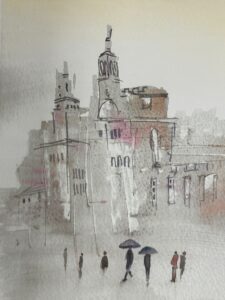
Those of you with experience may realise straight away that this may be better on a slightly smoother paper. It is also painted using a wet on wet technique, which means putting lots of water on the paper and letting the paint flow on the surface.
Sarah said that 200lb paper would be best. Immediately we are into issues that can be confusing, with jargon in the advert or on the pad of paper can be somewhat off-putting. The good news is that Turner and his contemporaries mostly used writing paper to paint on with watercolours. That is because the writing paper of the day was reasonably heavy and had absorbency that took the ink but didn’t spread it around. The other good news is that, once you find a paper that works with your style, you can just buy it on repeat until you want to try a different way of doing things.
One jargon area is weight of the paper. Sarah specified that in lb (lbs), which relates to the, well past retirement date (unless you are American or old like some of us), Pounds and Ounces system. So we already have lb, lbs and pounds for one measure.
Another, more universal, measure is GSM, which is grams per square metre. The trouble is that there is no easy conversion between the two. That is because they measure slightly different things. Both are slightly odd in measuring on a flat scale (e.g. square metres) something that can have a whole range of thicknesses. Then, for a particular thickness there can different densities. Oh dear. So 200lb watercolour paper is usually 425gsm. That is a heavy paper. Because I have it, I used some old hand-made paper that is like card for the workshop. For most uses I would buy the heaviest that you feel you can afford both to buy and to waste. If it is lighter weight you can stretch your paper (wetting it till it expands and taping it down while it dries to make it tighter and less prone to wrinkling) but that is not without its problems, or you can put up with the wrinkling but that just makes the painting harder to control.
Let’s go back to the texture of the paper. This is indicated in various ways. It might be a reference to a particular way paper was made once e.g Bockingford or a manufacturing technique (NOT or Cold Pressed). Papers move from smooth through those that have a quite pronounce 3d texture. Some famous watercolourists used the texture of the paper to give visual texture to the paint. Sarah talked about adding texture with the paint by bleeding or removing colour from particular areas. She also introduced the idea of denting the paper (with the end of the brush handle) to make the paint pool in those areas. That way you get the effect of different paper textures where you want them, not all over the paper. Textured papers are like the wrinkled paper, there are peaks and troughs and pigment runs into the troughs. There is also more surface area, because of the little bumps, so that can make the paper appear relatively more absorbent. Apart from the little tricks that you pick up, I would get a small amount of each and play with it to see what happens. Then, alongside the weight you can afford, pick the paper that feels like the ones you were most satisfied with.
The final topic here, at least for the moment, is absorbency. Paper is lots of fibres squashed together. The paper often has glue(size) spread over the surface to fill in the ends of fibres that are facing upwards and to make a paper with a more controlled surface texture and absorbency. Some papers have size internally as well. I wouldn’t bother thinking about this too much. Just try experimenting over time, ask people who do it a lot or perhaps you could read up a bit. Just remember that people love to repeat the little they know as, often inappropriate, wise advice (including me of course).
I hope the message has come across to keep trying different things. If it helps, make notes, so you can recreate the successful efforts. I know I had enormous fun playing last night, painting in a way that was different to much that I do normally. I was happy with what I produced and will add it all to my stock of different options when I set out to paint something.
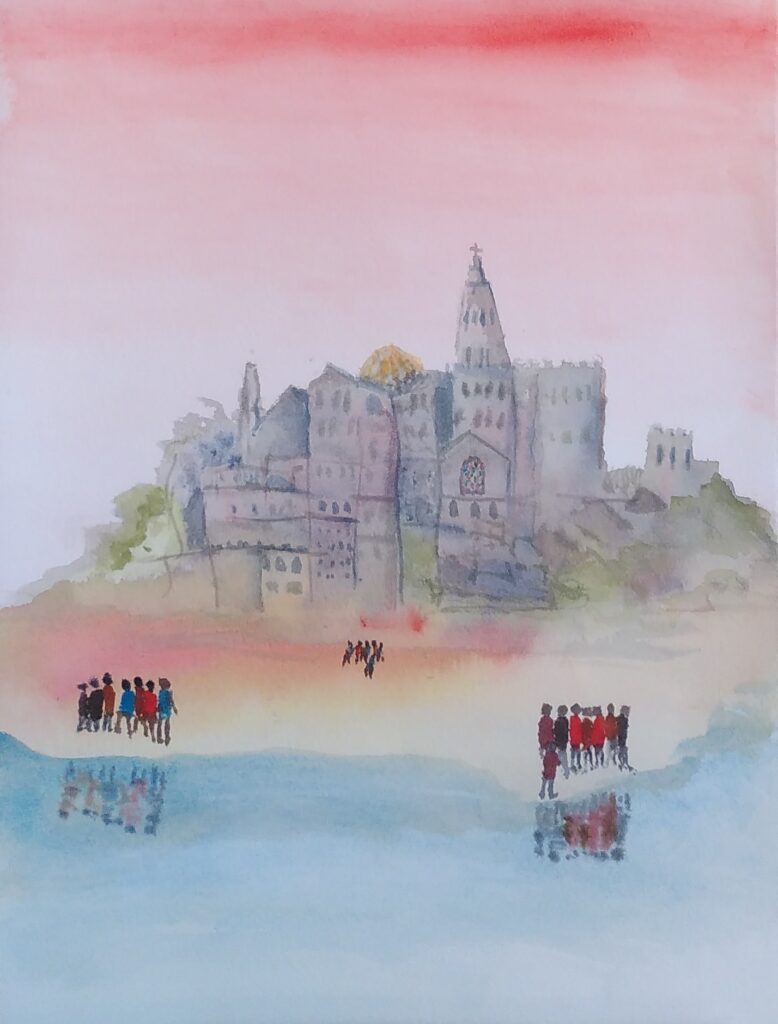
Of course, I had the right paper for the occasion, watercolours in tubes put into a palette that I use all the time, brushes that were of reasonable quality and that I am used to (the main flat brush I used is nearly sixty years old). So keep it simple, try different things in a reasonably organised way and be prepared to ask questions. Mainly have fun.