Yesterday evening Stacey Shaw gave us a session at Shelley Art Group. This is my attempt to summarise the messages she gave us and to add my own angles on it. Stacey reminded us that it always worth remembering the basics and used some good teaching methods to get across the messages clearly.
We started out with an arrangement of white cube, sphere, cone and cylinder. Stacy asked us to think how we could start to establish the shape on paper.
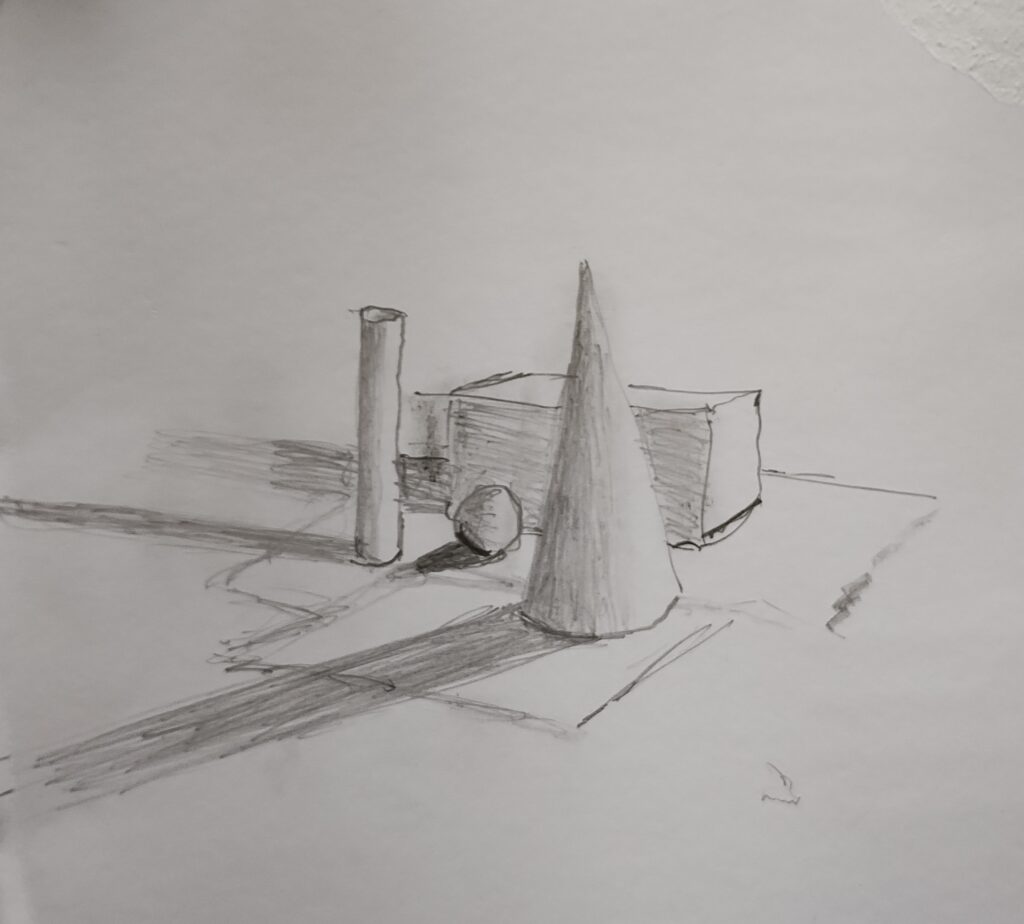
The cube has defined lines that give us its shape. It makes sense to sketch those lines in, if only to establish the perspective (if you want to stick to that perspective).
The sphere looks like a circle but we can usually see straight away that it is a sphere. Drawing the outline can help you to make it circular rather than some other shape but you run the risk of giving the sphere an edge. It’s optical edges are defined by where it goes out of our line of sight and where the background objects disappear behind it. You could begin to detail the shape by putting in the background objects.
Both the cone and the cylinder are versions of the sphere but with edges. If you chopped the sphere in two, you would have a sphere with a tricky perspective circle, in effect making it a figure with two faces. To indicate the shape better you could make lines that follow or indicate the shape and that would allow our brains to pick up those hints. To get a more nuanced shape definition we use the light which gives us shading and shadow. Tracey put a light on the objects to emphasise both of these. She also told us to make sure that we were constantly looking at what was actually happening with the shade and shadow and not making assumptions about what was happening. When I came to draw the grouping of objects I soon realised that the light source was slightly rounded, exaggerating the way the light radiates out and both the shading and shadows went in different directions for each object. When the close, directed, light was turned off there were multiple shades and shadows from the many lights in the room. Also the object themselves reflect some light onto other things around them.
That of course is the simple bit. Tracey quite rightly had a moan about denigrating art in education, when it is actually a very complex subject with multiple technical and social aspects to it. I’ll now try to set out, briefly, some of the other lessons from the session.
Without getting tied up by it, always try to remember that every object that you draw is a shape like these ones. It will have actual edges, points where it disappears from our view and surfaces which have a shape of their own (concave or convex, facing us, angled to us etc.). Even texture is a set of mini shapes on the surfaces of the object. There will also be perspective.
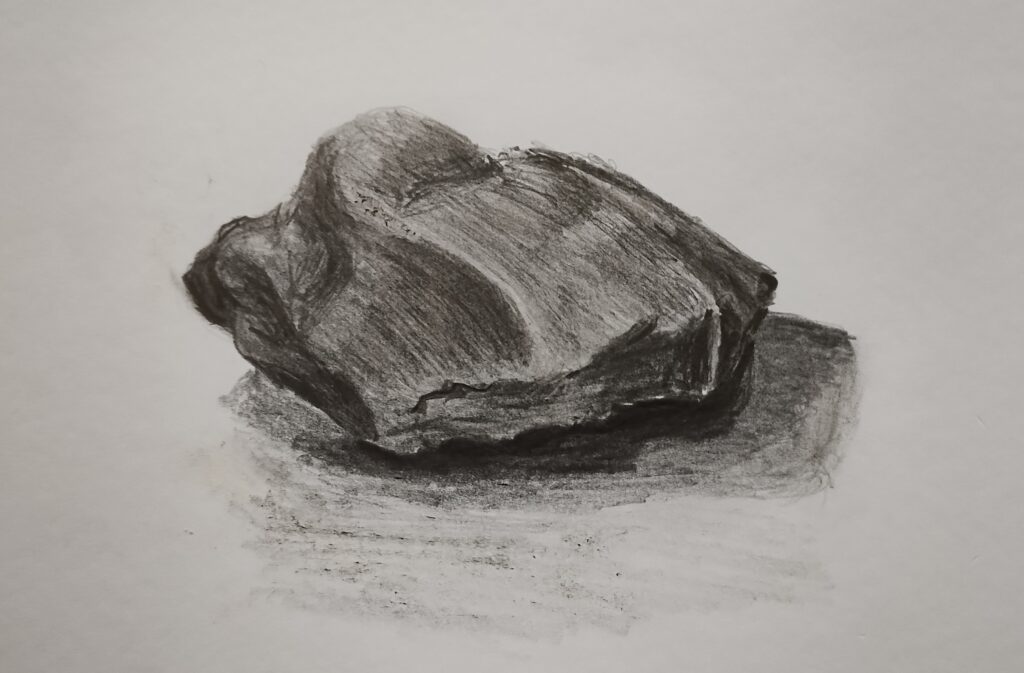
Try to resist getting too caught up with drawing edges on things.
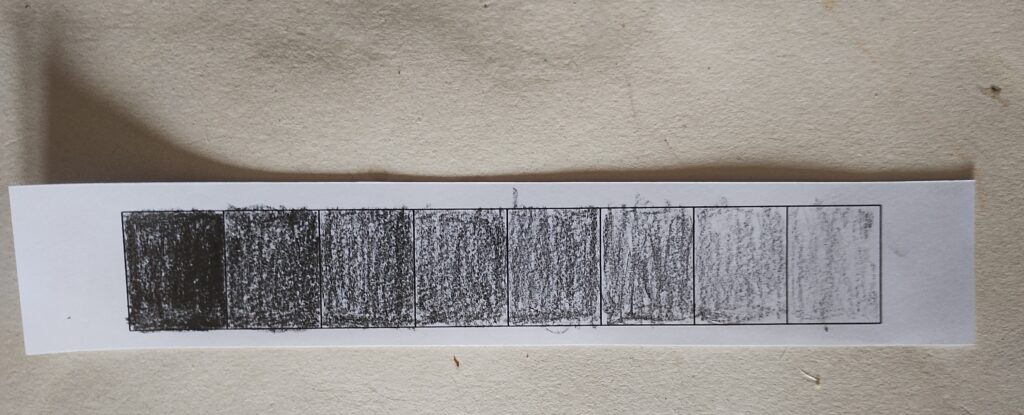
Using the shape information, try to separate the effects of light and shade from the competing shades given by the colours of the object. Tracey gave us a strip of squares to shade from dark to light. If part of the object is light yellow and part dark blue, the shading differences given by the lighting and shape on each colour are likely to be mostly consistent across the colours.
Where object have colour, the reflected light from them has some colour also. This can affect adjacent objects.
When you are drawing or painting try to make sure that your body, arm and wrist positions allow you as much free, smooth and controllable movement as possible when you are making your marks.
Keep comparing your version with what is in front of you and remembering the basics set out above. Look at what you are producing from further away, as this gives you a better sense of the overall shape.
Of course these guidelines are mainly of value if you want to produce a persuasive facsimile. That isn’t the only aim of most pieces of work. It does help to have learned how to imitate things even if your aim is to do something else with them.