
I should have put Questions in that title but it was getting a bit wordy. Hopefully it will make sense in a minute.
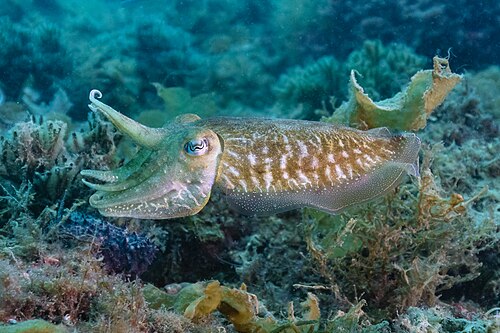
Let’s gets straight to the catchy bit. Like many living things, cuttlefish reproduce by mating and one common tactic in the mating game is for males to try to become dominant or ‘alpha’. Unlike most of us, cuttlefish can change their surface colouring (other than by adding makeup or foolishly sitting too long in the sun). They do this in response to stress and as a way of sending messages, like bird calls.
Now, people who look at evolution too simplistically see the ‘dominant’ word and think that is all that matters. They rush out and buy supplements and sit staring at themselves in gyms. This applies to all genders and sexual preference because dominance applies in a groups.
The cuttlefish is a good example of alternative strategies. The males, especially smaller ones, can adopt female colouring on the side facing the dominant male and a male display pattern on the other side. Clever. Some males also herd females into a hollow and sit over them, getting exclusive access. Other clever males can even adopt full female colouring and sit in the pile under the dominant males quietly mating when the chance comes.
So far so very male minded. The male cuttlefish is either a bulky bully or a sneaky smally. Evolution is way more complicated than that and females instinctively know it (they have evolved that way). The classic male interpretation of the herding into a hollow habit is that the females trade some loss of freedom for protection and access to the dominant gene. How simplistic.
I have said elsewhere that evolution is the survival of those that happen to survive, to try to emphasise this complexity. The statistics will indicate that there is no one way for a single individual to predict what will make their offspring survive. There are options that are simpler to adopt and that also sit higher up in the pile of options but there is also variation in both mating and offspring care adopted. This indicates that the statistics often favour those who adopt each way bets. So females let the dominant male sit there on edge guarding his harem and then sneak off and mate with other males who have shown the resilience not to give up and the wit to appear in the right place for the opportunity to arise. That ensures the most favourable balance of gene survival to deal with the complexities of survival. Females also mate with multiple males to let the sperm and ova do the selection.
So what has all this to do with reasoning? The first stage of reasoning is hinted at above. You only get past the simplistic understanding of evolution if you ask questions. The questions to ask here are ‘how does the male cuttlefish decide which range of colours to adopt?’ and ‘how does it decide that fighting is not the best option but sneaking into the hollow has good chances’? If you think a bit further on from that you can ask how the successful adoption of a tactic get passed on to offspring? Is it a better instinctive colouring ability or a brighter brain?
Of course I don’t know the answers to those questions but the existence of the questions has wider implications for the ways we reason about all sorts of things. Sadly the habit of asking questions seems to have got a bit lost in some of the narrower, results led, approaches to education that we have adopted. We already had a habit of using reasoning to show dominance in various ways, because as well as helping people recruiting others to jobs and courses, exams and qualifications have always been used in that way. I think we are in danger of losing the habit of asking questions about our own reasoning. As with evolution and the cuttlefish we need to keep our options open. We must remember that the ‘fitness’ to purpose of a person can’t simply be measured by exams but also involves adaptability and the ability to ask relevant questions.