Hubris, vanity, ego, whatever you want to call it we are full of it. I certainly have it but try to keep it under control. Weirdly, I came up with the idea for this bit of writing after being irritated by an TV program on cave art. What art is and its role in life is little side interest of mine, and early art is part of that.
The program was about the wonderful and varied cave art at Chauvet. As usual I couldn’t help noticing when the admirable experts and program makers put across messages that were slightly more open to question. We all do that too, making sweeping statements to convey our message more impressively. I went researching and a series of things I came across gelled into something I thought worth saying.
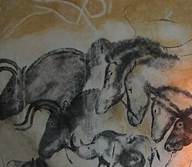
Let’s start with the art. Art is built into all of us. If you make clothing, personal decoration or decor choices that is a form of art. Current research suggest that people have been making art for around 70,000 years. That is not just us, the badly named Homo Sapiens, but also Denisovans and Neanderthals
Art is a form of communication. It is also about display, attraction, entertainment and showing off. Animals of all sorts select objects to show off, make structures to attract, do dances and carry out mimicry to attract interest, sing to draw attention and to ward it off and a whole range of other things of the sorts that underpin all art.
You can discuss forever what makes good art, what conveys more meaning, what is more moral, what is prettier and so on, but it is all art. Likes and dislikes are personal. I really dislike Faberge eggs. I admire skill but there is much in the world that I think of as fashionable rather than admirable and I don’t like fashions and fads in general. Give me a good cave painting any day.

In the Chauvet caves there are a full range of marks and techniques. These seem to start at the front end to the cave, with simpler marks, generally in red ochre pigment and range to further back, generally in charcoal and with more sophisticated representational elements, such as lions and bison.
I have to be careful here of that word ‘representational’. It is a word that people load with hidden meanings of superiority in one way or another. People can dismiss abstract art because they ‘can’t see what it is’ or others can equally dismiss art because they (or more often others) can see what it is and therefore ‘it lacks sophistication’.
In Chauvet the work at the front consists mainly of patterns of marks and sprayed hand prints. These are almost certainly earlier and perhaps show less sophistication of technique. The important word here is ‘technique’. Some can be born with a more natural grasp of technique but all can use practice to develop technique. In addition we can also learn technique from others. Human species are not alone in possessing this range of technique development skills.
Finally we come to the question of who did the cave art. I’m not going to speculate on Chauvet because I don’t know. Looking around statements that people make about cave art and relating it to evidence we have about our own development, highlights the hubris contained in those statements, as mentioned in the title here.
There is suggestive evidence that we lived in the same timescales as Neanderthals and Denisovans for a very long time and that we almost certainly shared locales with them at the same time. Ancient DNA evidence is hard to find but what there is indicates that we share DNA with Neanderthals. How much sexual activity there was we can only speculate on. It is not impossible that the same is true of other hominids. Their development is not completely clear and classification of them is based on the usual, often tenuous, observation of characteristics that we think can be useful in grouping things together or separating them. Taking those classifications and using them to speculate about behaviours, meanings and who did what can sometimes lead to a narrowing of views and options.
What I’ve written so far hides the thorny question of spirituality, which is often attached to discussions of art, archeology and many other things. Elsewhere I have speculated about dogs sometimes going round in circles before lying down. How do they decide when it feels right to stop the circling? ‘Feeling right’ is not really defined by argued logic. That doesn’t make it superior to argued logic. It can’t be explained in a rational way. Sprituality is just one shade of that internal feeling of right or wrong. We need to recognise that what feels right or wrong is fundamental to our existence and therefore needs respect alongside logic and reasoning. As far I can tell philosophical attempts to define right and wrong have always failed to come up with a consistent way of explaining it.
So we are complicated and we are all different mixes of complicated. There is no foolproof way of defining or describing what we do. I suspect the best art contains elements of every aspect of our personalities. It is personal but we can also discuss aspects like the number of layers of meaning in a particular set of work and how well it communicates both layers of meaning and feeling accurately to the rest of us.
Neanderthals definitely made art as I have defined it here. Over time our ancestors developed and passed on all sorts of new ways to make art. I don’t think attempts to judge the sophistication of what our predecessors produced have much value. Trying to use such judgements to artificially categorise and separate us from some predecessor is not very useful. It is the equivalent of colonial assumptions about superiority.
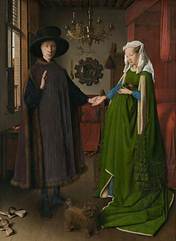
Whether layers of meaning and spirituality have increased alongside the development of technique is another matter. Though I don’t believe in vague ideas of spirituality as something outside of us, I think there is often more value in the work in Chauvet and similar examples, on nearly all levels, than there is the Arnolfini Portrait, which was in one of my first art love affairs. I also think that the questions behind what I’ve set out are a good way of thinking about art: Does it make me smile, Does it uplift or move me, does it give me a message, have I learned something from it?
I hope some of the things I do make some people answer yes to some of those questions and I hope I have helped you in both enjoyment and understanding.