Categories
Art Chairs

Patience, skill transfer and what fits

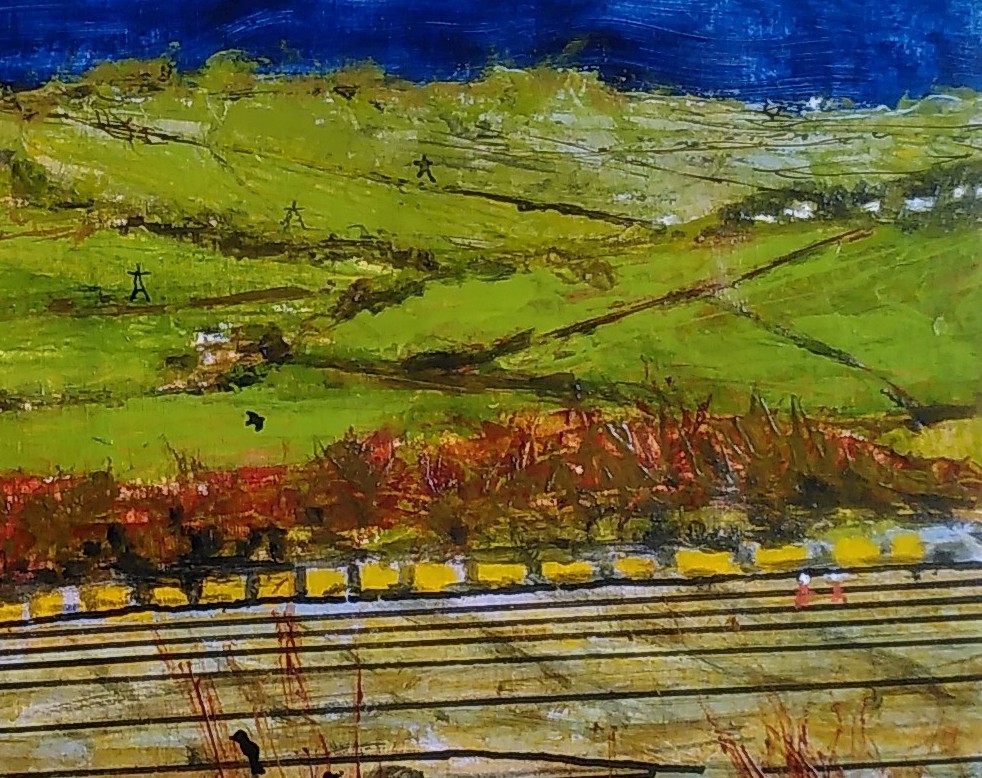
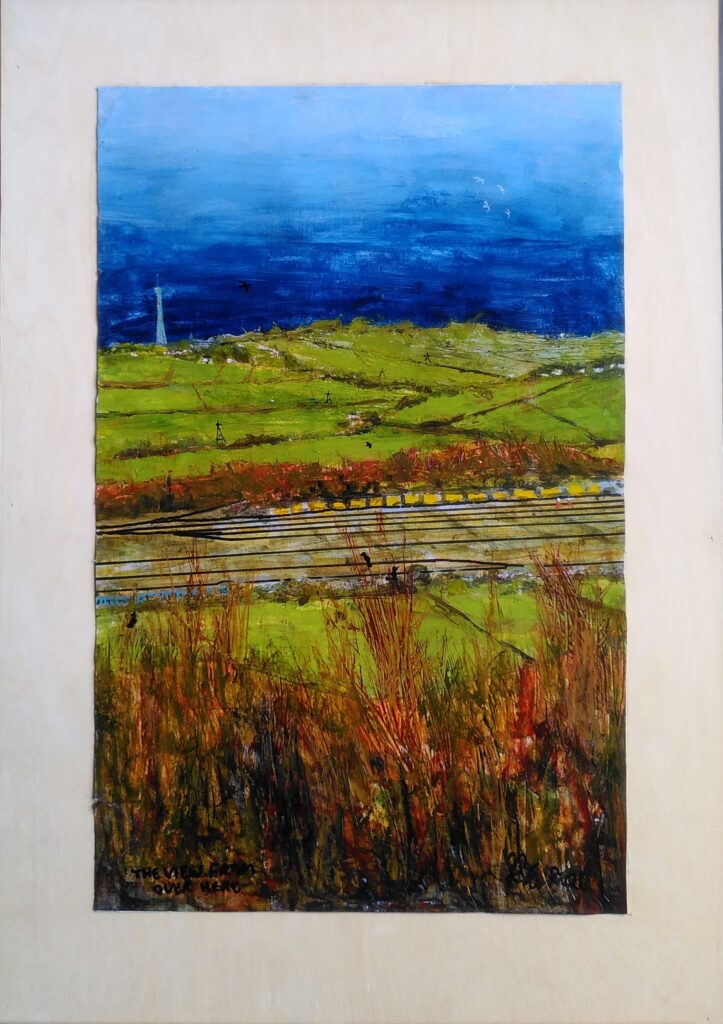
I’ve just had a bit of a bad few days with one painting. It was going well, blending skills I have recently learnt with older ones and trying out some new ideas. I have learnt to add visual complexity and detail using a palette knife. That is particularly useful because of my tendency to shake and twitch (see the sudden bend in the rail line).

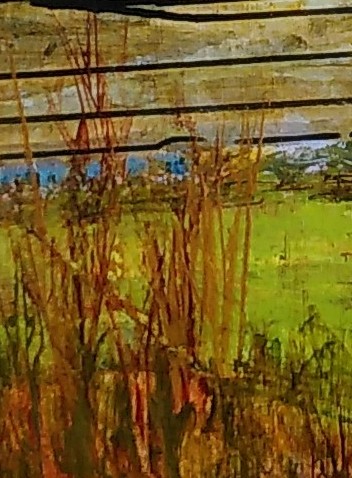
That close-up also shows that I have not always learnt to overcome the difficulties of sequencing in painting, with the rail line going over some of the foreground vegetation.

The rail lines and other similar details are another problem for me and the shakes, as I seem to get worse if I try to measure and use a ruler. I’ve learnt ways of relaxing before trying to make marks to reduce the shake and I’ve realised that we only really notice detail in particular situations, such as those rail lines and even then they don’t stand out in larger numbers

I was experimenting with various things to overcome some of these difficulties and have been trying acrylic pens, which seem to work except that they are a bit inconsistent for me. This is where another persistent problem came into play – failure to concentrate. In that close-up above there are crows and pylons (I love Pylons and wires). I didn’t have a black acrylic pen, so grabbed the finest black marker I could find and it worked, until later when I over hastily put a layer of matte varnish on. Without me noticing at first, the varnish simply smeared and wiped out all that detail I had put on. Arrgh.

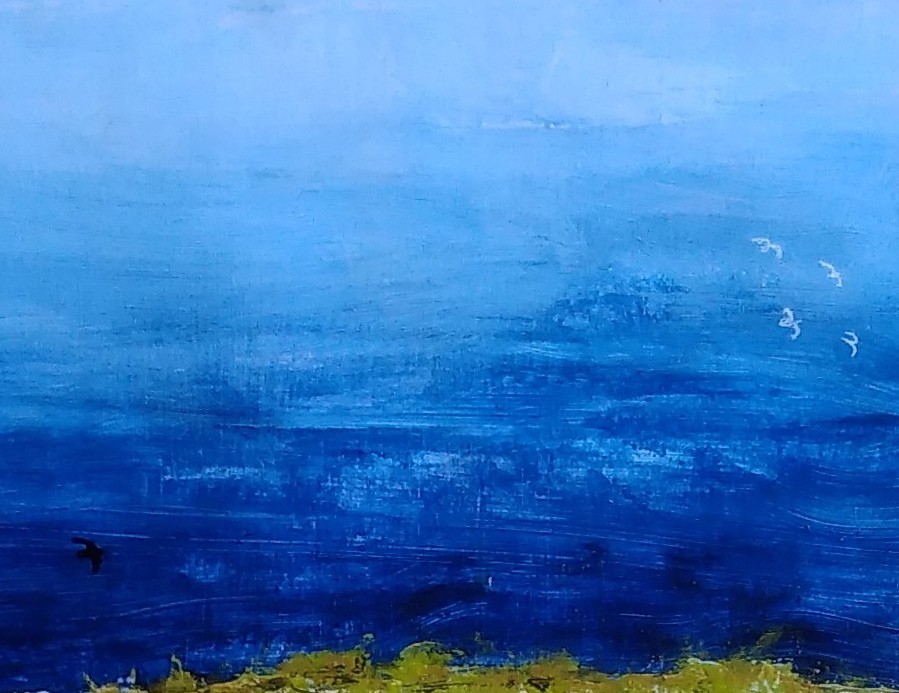
This is where that other skill that age has taught me comes in – patience. Instead of having a minor tantrum and tearing it all up, I bought some acrylic ink and tried some experiments (on a spare piece of paper this time) using my ancient dip pen. I hated dip pens when we used them at school but this seems to have worked reasonably well. I even went as far as to add some gulls in white.

Even so I then reverted to type when it came to sticking the picture on to a cradled board support. For all my my measuring and marking, I manage to stick it down upside down and slightly skewed. Time for a break and some of that patience and persistence. Using my newly learned skills with palette knives and scrapers, I came back and carefully manged to remove it from the board with only two minor tears. Here is the corrected result.

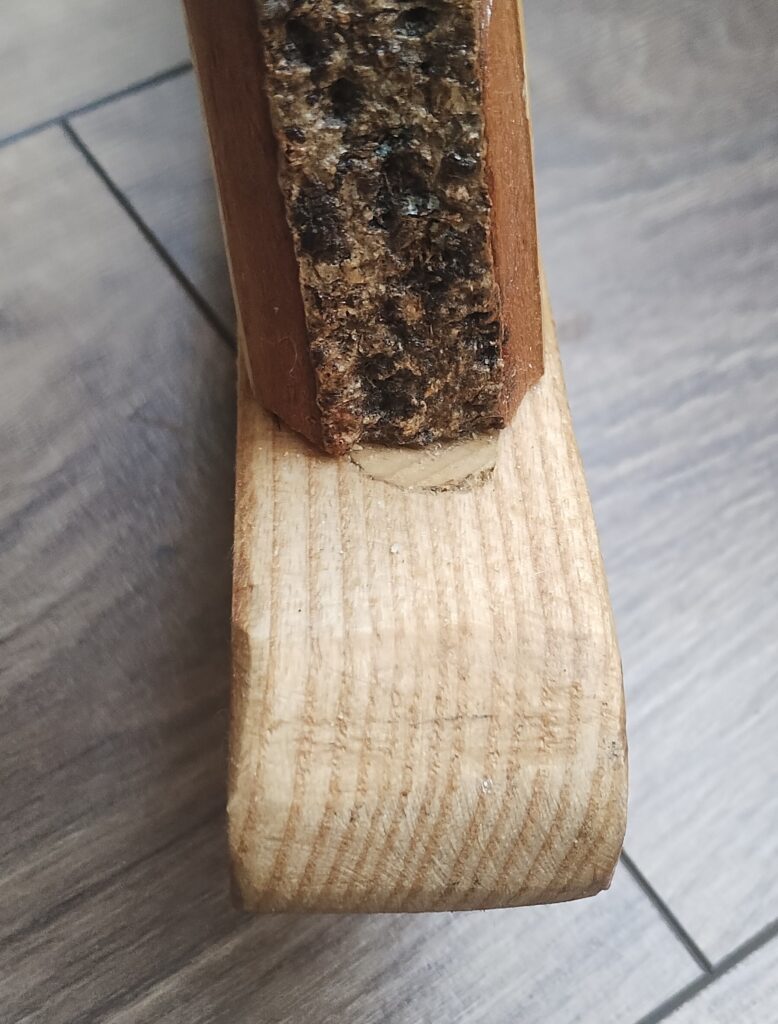
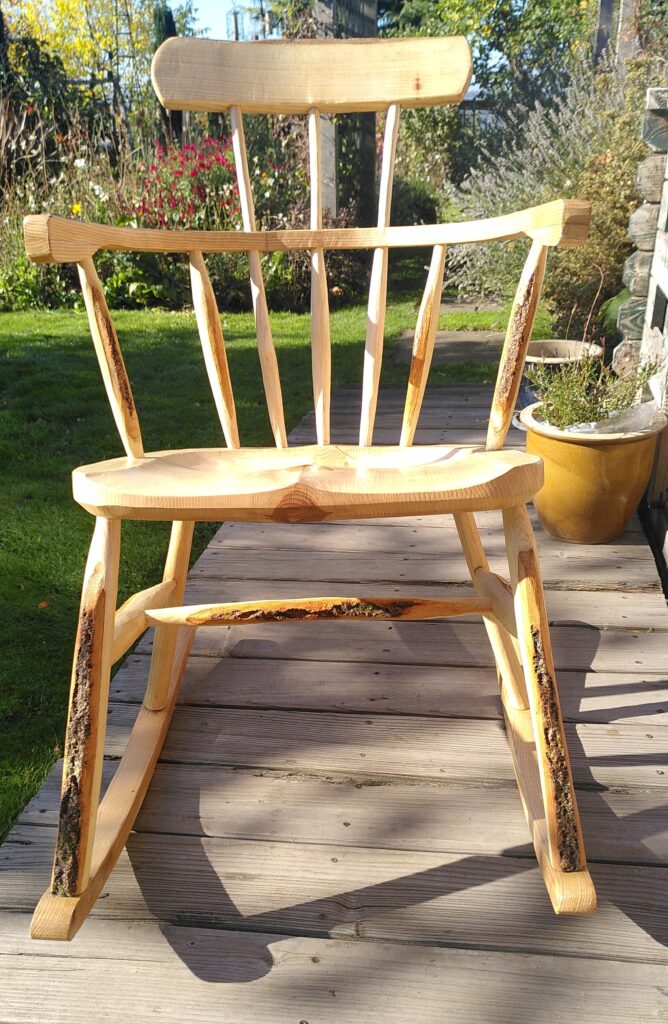
Of course these messages also apply to everything you do. Even after several years of chair making my brain would go AWOL but there are always remedies. This is a detail from my last chair showing that I had to take it apart, fill in the hole in the wrong place and drill it in the right place. That is still probably the chair that most captures my style, warts and all.

Have fun and keep at it.

Categories
Food

Unexpected Harvest

On Monday Ruth was clearing one of the longer vegetable beds (they are all actually mixed flower/veg beds). We’ve got into a habit of treating brassicas like Purple Sprouting and taking heads of, leaving the plant to do its own thing, unless we need the space. During the clearing it became clear that the cabbages had developed multiple little loose heads, the Autumn broccoli had developed nice little sprouts, some spinach had developed a few vaguely acceptable leaves and a little patch of beetroot that was too small to harvest hadn’t entirely given up the ghost. Ruth saved them and passed them over to me.

Ruth and I are both on the same side of one of life’s great divides – Beetroot. I have a policy of keeping on trying things until I find out what it is people like about it and after many years of failure I discovered that Beetroot with goats cheese, really worked, especially if the beetroot is roasted. We eat it regularly now.

With that is mind and what I had in the house I came up with the following vegan recipe, which went down very well.

Flavouring – 1 tsp Allspice, 2 tsp sumac, 2 tsp ginger 1 tsp cardamom powder added to 1.5 tbsp olive oil in a roasting tin at 180 degrees fan oven.
Vegetables – 1 medium red onion, 1 clove garlic, 1 carrot, 10 small beetroot, 2 punnets of brassica tops, tin of sweetcorn,
To add at the end – 1.5 tbsp nutritional yeast, 1 dsp vegan bouillon powder, 100 ml water.

Process – Clean and if necessary peel/scrape vegetables and cut into long pieces not to thick. Remove any hard stalks from the Brassica tops and clean up.

Starting with the beetroot and carrot, pre-cook the vegetables (other than onion, garlic and sweetcorn) in the microwave and add in turn to the hot roasting tin, putting the onion and garlic in after the beetroot has cooked crisped up a bit. When the leafy bits are starting almost to turn into crisps, add the sauce ingredients and the sweetcorn and return to the oven for around 5 minutes. You can turn the oven off at this point.

We ate it with toasted home made bread and there was a little bit left for lunch today.

Categories
Food

Saffron,Turmeric and Mint Winter Vegetable Roast

No pretty pictures, but a fully enjoyed concoction.

In the roasting tin – 2 tbsp olive oil, desert spoon turmeric, tsp saffron, desert spoon mint, ground black pepper.
Winter vegetable mix – equivalent of two medium main crop potatoes (whatever type of potato is your favourite), medium size cauliflower, same of broccoli, 2 carrots.

I have a standard technique of putting the roasting tin in the oven, with oil etc., at around 225 degrees at the same time as giving the potatoes 5/6 minutes in the microwave at full power in a Pyrex container with lid then dropping them in the hot oil, turning over and returning to the oven. Each vegetable gets started off in the microwave in turn – Cauliflower 5 minutes, Broccoli and Carrot 4 minutes.

While the broccoli is in the microwave add half a red onion and 1 clove of garlic (both chopped) to the roasting pan and turn in.

While the vegetables finish browning nicely, mix 2 tsp bouillon, 1 desert spoon of nutritional yeast, 2 tsp soy sauce, 2 cup water. Add this to roast vegetable mix, turn over and brown off a bit more.

The aim is for each vegetable to be just cooked, nicely browned and gently soaked in the sauce.

Categories
Art

Failing to Portrait

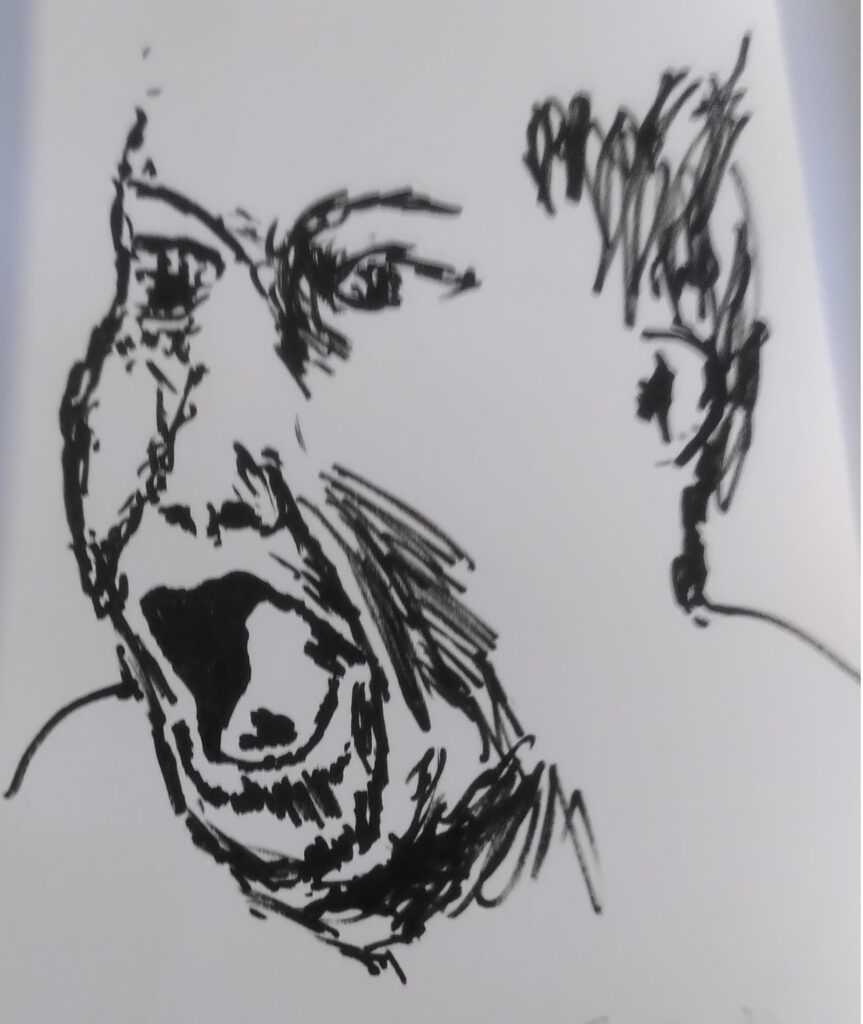
Of all the art works I’ve done over the last 70 years, the ones I’ve had least satisfaction with are portraits. Thankfully when I think of all the art I’ve looked at there are very few portraits by other artists that really please me as well. The Uffizi gallery with all those virgin and child, cherub filled pieces is by far the least enjoyable gallery I have ever been in. That’s personal of course. I am not even very keen on photographs of people.

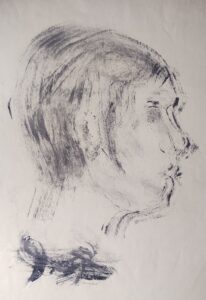
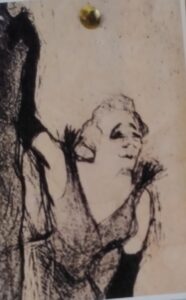
Oddly an early pencil sketch I did of my grandad, really captured the subject and may still be adorning some wall up in Barrow-in-Furness. On the other hand I have been failing to get the scene below right for at least 20 years, mainly because of the singer’s mouth. In general the difficulty of portraits varies from side profile old men through a scale to full body young child. Animals seem to be easier, though horses are less so.

While this one from 1967, done with shoe brush and polish still works better for me.

Some people are such natural mark makers that they can capture people with real economy (Hockney, Daumier). Other artists chose a different tack. They concentrate on capturing character, movement and a sense of life. For me that is usually more successful to look at than more literal works. Below are some of the pictures I have on my wall, because they inspire me without making me a copyist.

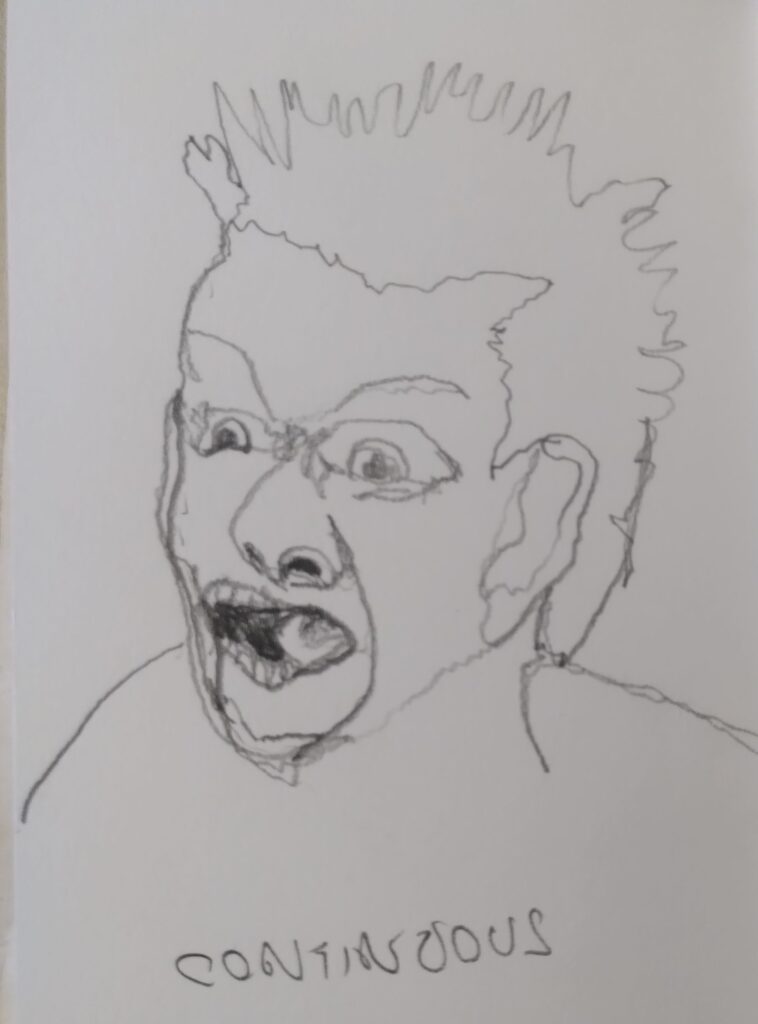
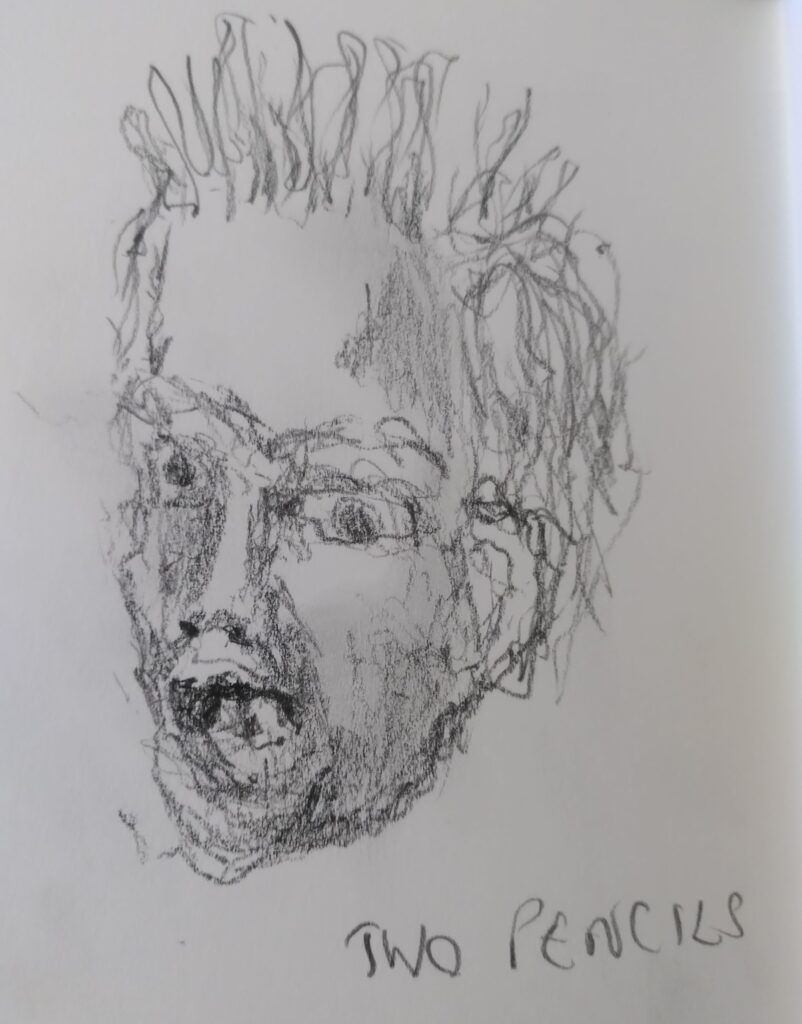
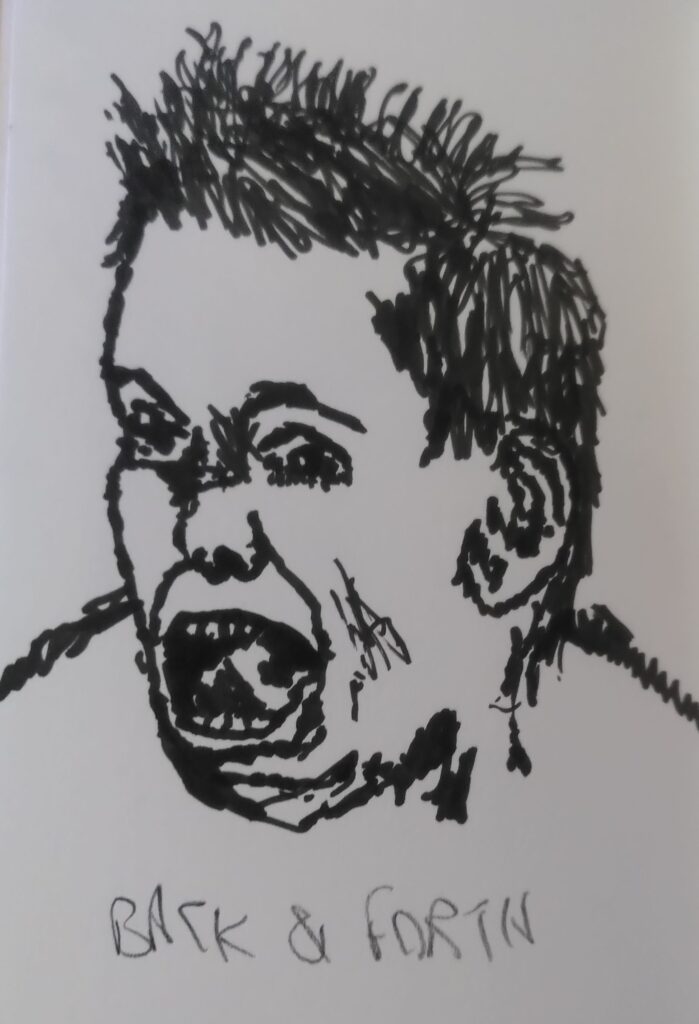
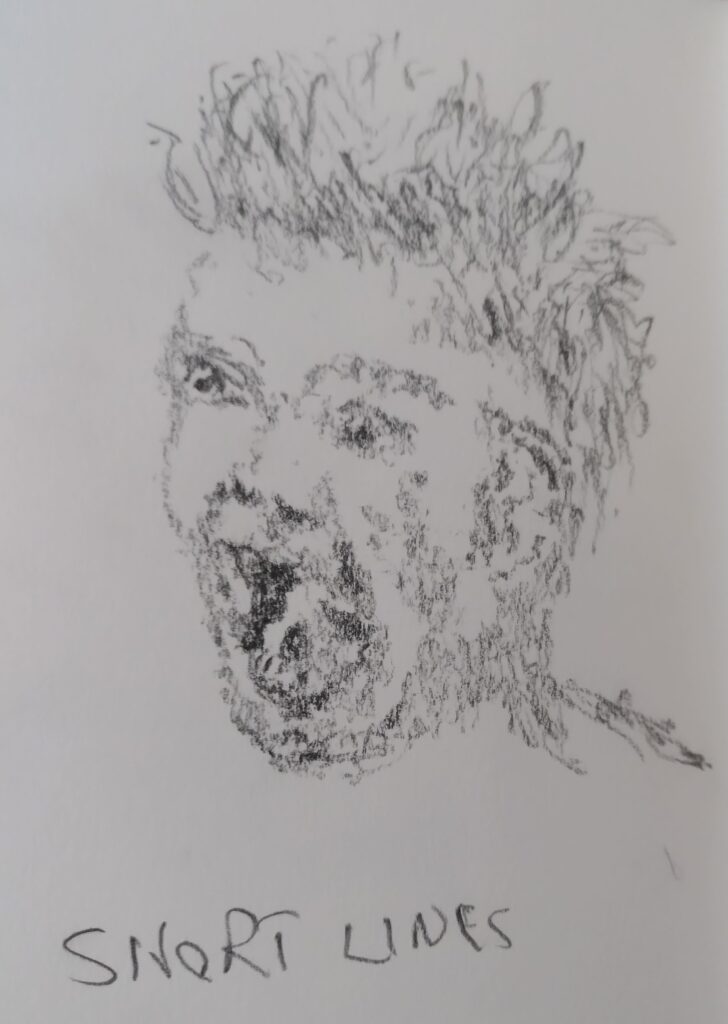
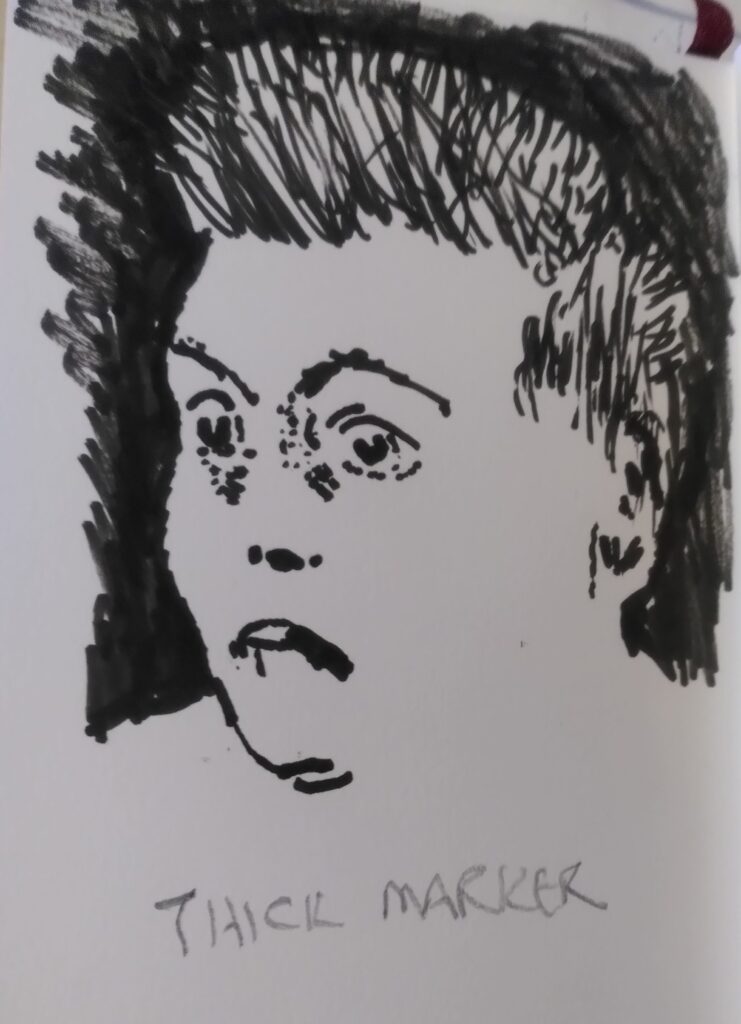
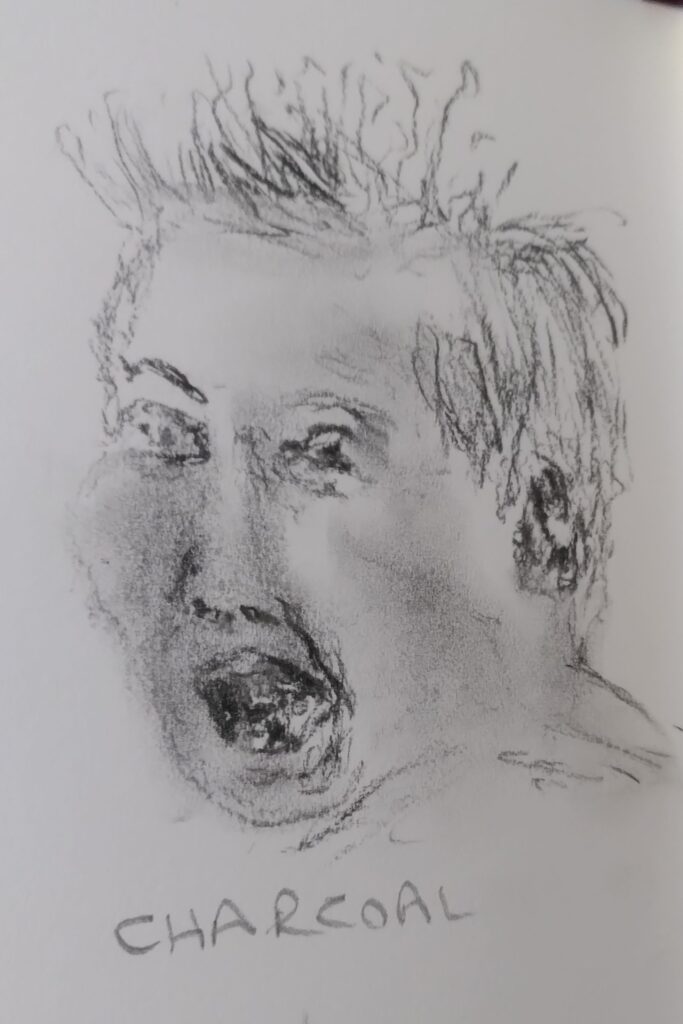
Last night we did an exercise, thanks Wayne, doing 6 minute sketches,using different techniques, from B&W photos. I used the same photo each time, which is at the bottom. I think I’ve got the order last from first at the top. There was also a last one using the wrong hand, but I excused myself that one. For me the charcoal one struck me, as it started out well, with the hair, but the more I got into delicate detail the more my shaky hands betrayed me.

Categories
Art Paintings

Pippa Ashworth Workshop

Yesterday I was at a Contemporary Landscape Painting workshop with Pippa. It was very stimulating, so I thought I’d pass the basics on.

We started by dividing a good sized piece of reasonably heavyweight cartridge paper into three rows and then making marks across each row with palette knife and undiluted acrylic paint. Desperately not thinking of landscapes we used a dark, medium and light colour in each, perhaps with a warm or cold colour relationship.

Make sure to leave a good quantity of white paper. On one row at least the dark should be black. The marks should overflow to give colour and texture subtleties. There should be slightly stronger areas of pigment and others could be almost scraped off. Don’t get too fussy.

Next take a small mount cut out and keep laying it over the paper to see if any interesting shapes or images emerge. You can twist the mount at whatever angle works. Pick as many images as you fancy playing with. They can’t overlap, as the next task is to cut them out and stick them to a sheet of paper to work on. In those bits you can think about landscape at last. You can paint over any bits that don’t work and add detail that adds more shape, distance and texture.

Lastly we did some larger (but still small for this exercise) pictures using the same stages on each piece of paper – Making flat marks in three colour shades, with different strengths, overlaps and textures. Doing it reminded me of Heather Burton’s advice to block in shapes quickly in flat colour at the start of a palette knife piece and the abstract session where we folded a paper that we had worked on to highlight different sections and stimulate new ideas.

The exercise aimed to give more liveliness to compositions. Using flat acrylics allows you to add layers of subtlety and detail afterwards.

Apparently in another workshop Pippa gave people, when working from a photo or someone else’s painting, the advice turn the original over for the last third of the time working on it. That way you turn it into your own work but also start looking at the painting in the way you need to better do your own original work. Sound advice.

This approach allowed me to free up a painting I’d been struggling with, trying to capture a day at Glencoe’s Signal Rock site, when there were many dragonflies. Not perfect but improved. Thanks again Pippa.

Categories
Art Briefings

When a Dog Lies Down

The feeling behind art

I’ve written elsewhere about how we should recognise that a lot of our behaviours, including art, a just our own versions of other animal behaviours. So have you watched a dog lie down? It is intriguing. First comes the impulse, then the spot selection, then walking on the spot in a circle, the head is down and the terrain is checked visually and in terms of scent and finally a satisfied plonk to ground. During this the dog will also be checking its environment, including checking on other animals it wishes to please or stay on good terms with.

That certainly describes a good part of my art process, except with drawings and paintings I am mostly walking back and forwards to decide when it feels right. I can’t help checking what others think either.

For some people art is almost like a meditation, where you are paying attention to each mark and excluding as many outside thoughts as possible. Does that sound similiar?

For others art is a way of expressing anger but the same is true of that too. You need to look for the point at which the demon has for the moment been exorcised. If it is just for therapy then that is enough. If you want to get a message across to others then you can also think about how well that has been achieved.

Even if you are just showing off, you still need to go round those circles until you have managed something that will light up people’s eyes.

Personally I think that the more technical art gets the more danger there is of loosing the feeling involved. If possible you need to manage to balance technique and feeling until you are at the point where you can plonk down and relax, at least for a short while.

Categories
Birds Small Birds

Little Winter Birds

Woodpecker and Long Tailed Tit Invasion
Edited Snippets of our most common and hungry bird visitors
Categories
Garden

Late December Smile Inducers

Categories
Art Sculpture

Art that Evolves

I had a discussion the other day about the fact that people often pay good money to have something look like it has rusted with age, the fashionable use of Corten steel being an example. I have a love of letting sculptures develop as they will over the years, with minimal interference and restoration. Wooden ones sometimes need more attention but I love the way the metal ones change. Different metals have different characteristics and alloying and oxidisation processes affect that. I think the sculptures have a better feel and texture if left to evolve, with minimal interference, though lately I have been using a weak oil paint and linseed oil mix on parts of them to slow and subtly alter the changes.

Here are some examples.

Categories
Briefings

Us, Thinking, Understanding and AI

In a previous post, on AI, I wrote that we still don’t really understand quite how we think. A comment by Ruth while looking at an animated weather map suddenly brought together for me a whole mass of observations and ideas that I thought might be worth putting down on Cloud paper.

So how do we get those sudden moments of apparent clarity? We know that it is to do with our constant monitoring and building of synapses, but we don’t really know what is going on.

Let’s get back to some basics. I used the word Thinking in the title, but for most of us that means just the tiny percentage of brain work that we are somehow also aware of as we do it. There is a whole complex set of process going on behind that. Those processes also do not end where our brain is either, they are affected by and have effects on our bodies. Recent research has unpicked some of the complexities of how birds manoeuvre , through foliage for instance, and it has highlighted just how complex and integrated all the information processing is.

Of course it doesn’t end at the periphery of our bodies either. Hive minds and the communication signals that pass between trees have entered popular imagination in recent years. On a personal level, I have been astonished many times by the speed of my reactions to outside stimuli over the years (and a few times by their failure too). While I have no chance of controlling the fastest reactions, my brain and body are also instantly busy categorising, analysing and planning further actions. Amazingly the same brain is also observing all this happen. In windy conditions, a huge branch nearly came down on me in the New Forest one year. I escaped injury, more by luck than reaction times, but it is still in my brain as some sort of learned experience. Not only that but I can now abstract from it and realise that the tree would have picked up signals from the falling and landing branch and my clumsy evasive dance would have been registered as well by both the tree and other life forms in the vicinity, whose own reactions would have effects and so on. It wasn’t just Ruth and I who were on alert that day.

Thinking about all that, we must remember that the complexity may mean that everything cannot be processed and analysed perfectly. Our brains have to sacrifice some detail for more useful gains in learning. Different living things and individuals inevitably have different abilities to process and use their experiences. I have always had difficulty holding onto names and numbers but that hasn’t stopped me from being fairly good at things, such as maths, that involve numbers for instance. Others will outshine me in some areas but fall behind in others. Everything is a compromise in one direction or another.

The same is true of AI and AI has another layer of difficulty to deal with, in that it often needs to find effective ways to communicate what it has found. Communicating involves reaching an agreed sense of meaning and importance with those you are communicating with. That is hard for us but it why AI is built, so there is another level of importance.

Continuation addition 2 – All round the world there are data centres churning away, using huge amounts of energy to do the work of our subconscious. Think of all those books being ‘read’ to look for patterns that may later be re-used to ‘create’ new works. The revelation, that this gave me, is that our (and other animals) brains are doing the same thing all the time, making links for patterns that might be used later. Ruth says that is why I’m skinny, because my brain never stops.

This takes us back to our maps. What prompted the discussion Ruth and I had, was zooming in and out on the map and the choices that the app made on what to include on the map at the different levels. Not surprisingly it failed to realise the relative importance of different pieces of information to us. IT, with or without AI, has always had this problem. In earlier days the compromise decisions were made by humans but they are now frequently made by code. Human decision makers are far from perfect but they often have an instinctive understanding of other human understanding. Despite all its advances and amazing powers, code still has trouble realising what is obvious to us.

This post ended previously here but I knew that I would end up adding more. Sadly, like all technology that humans have invented, AI is being implemented everywhere with little thought of balancing its positive and negative effects. I have just been searching for the likely origin of a phrase and the ubiquitous AI summary at the top of the search results made me laugh because it was preposterous. Not only that but there was a contradiction between the AI summary on the first page of results and that on the second page.

That reminded me of looking for information on help pages and chat sites. As a technical person I have been solving problems for people all my life but I always tell people that if someone talks jargon at you then that usually means that they have an imperfect grasp of what they are talking about. I’m used to separating answers with understanding behind them from those that either haven’t understood the question or are just repeating something else imperfectly understood. Currently, and sadly probably permanently, AI is often unable to separate sense from nonsense and is often providing answers that are the equivalent of the whispers of conspiracy theorists. It has moved from taking verified knowledge, to allow it to infer answers to questions, to using unverified statements for the same purpose. Take care.

Still to be continued…..